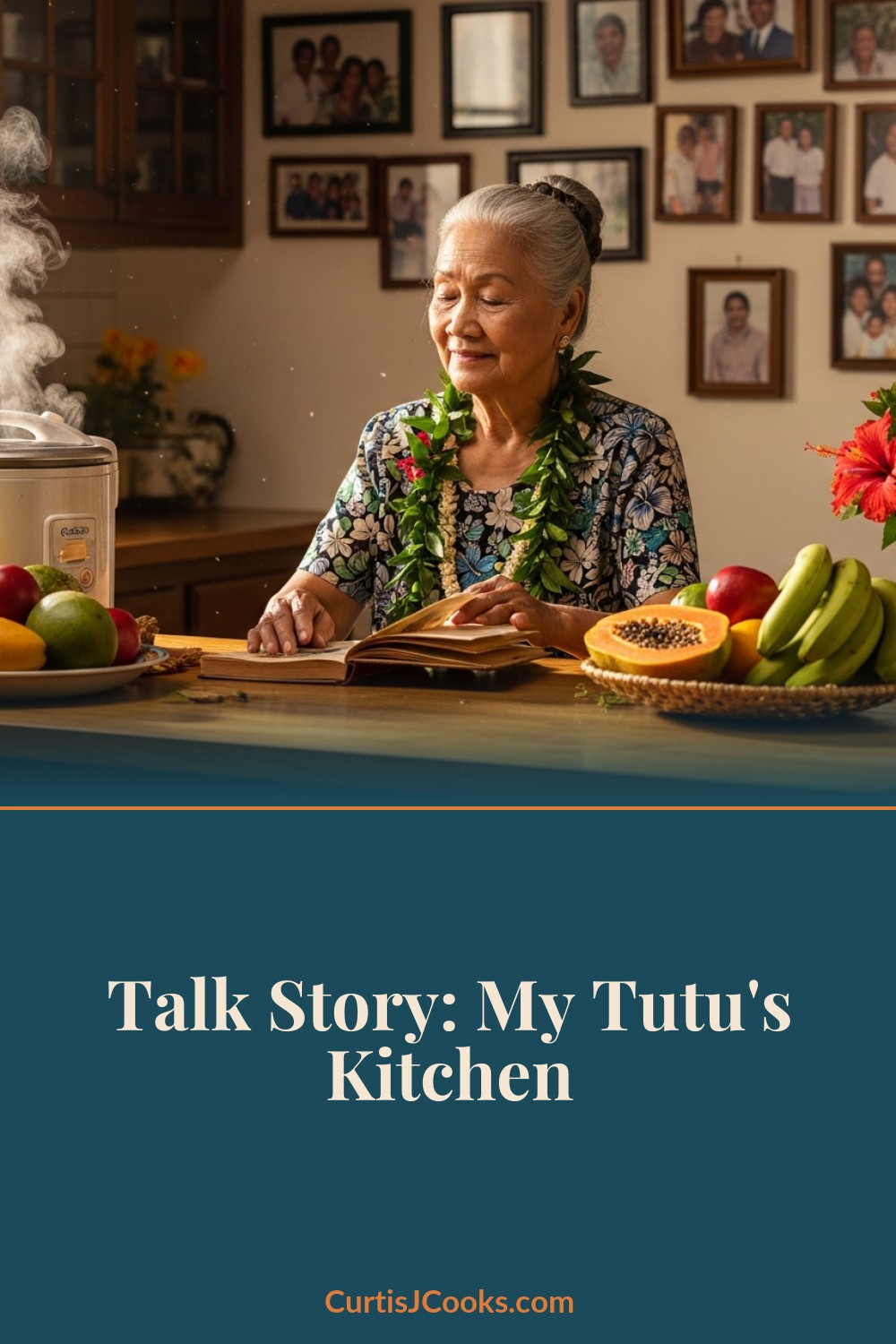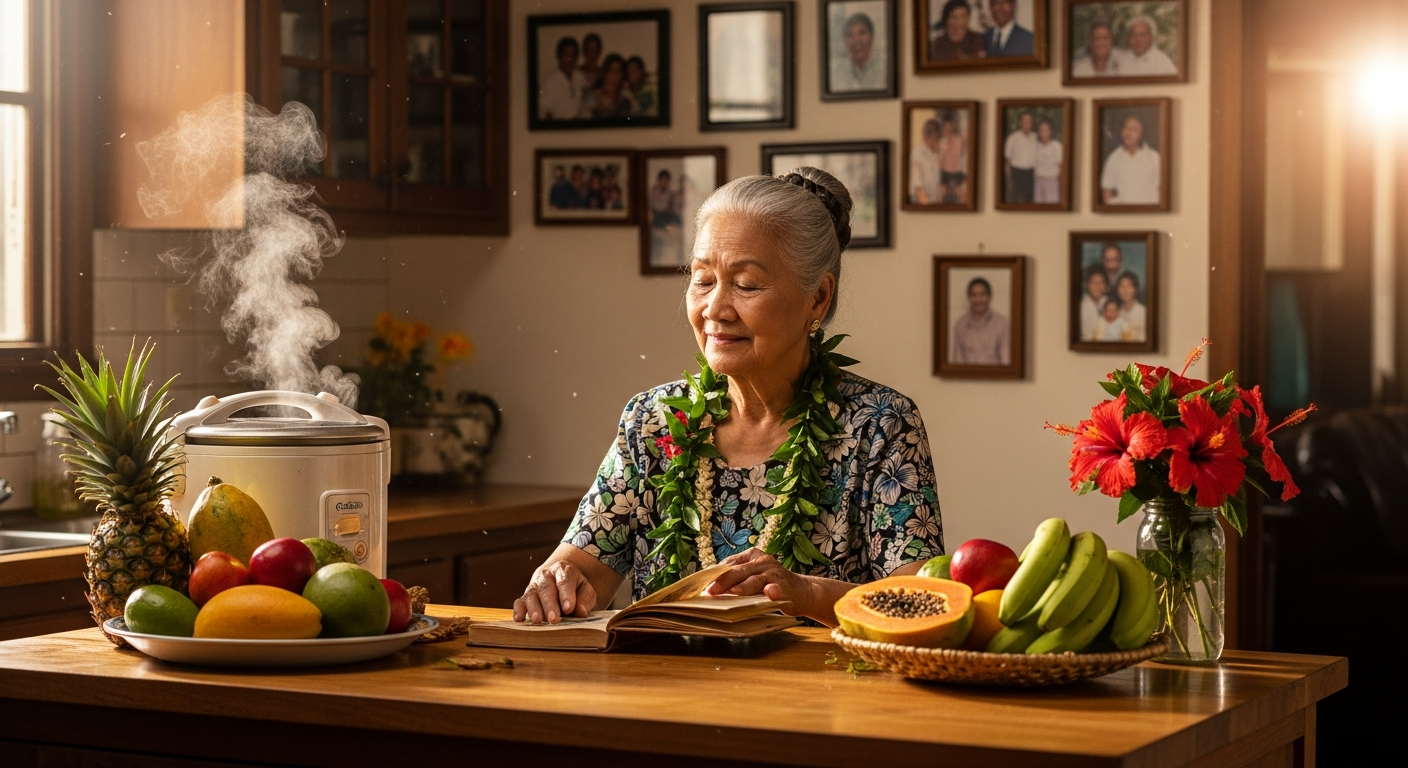
Some of my earliest memories are standing on a step stool in my tutu’s (grandmother’s) kitchen, watching her work magic with the simplest ingredients.
The Heart of the Home
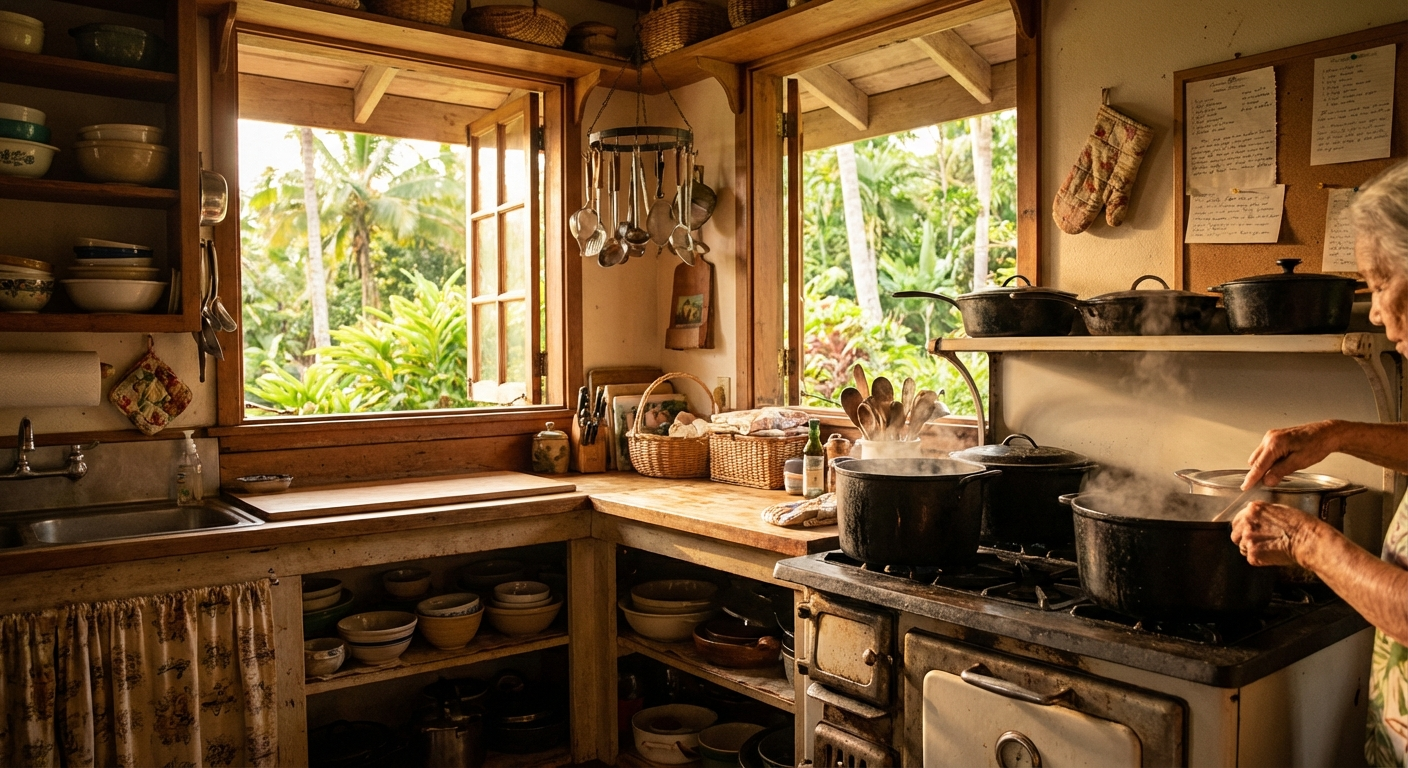
Tutu’s kitchen wasn’t fancy. Formica counters, a well-worn wooden cutting board, and a rice cooker that was older than me. But the food that came out of that kitchen? Pure love.
She never used recipes. “You cook with your na’au,” she’d say, pointing to her gut. “You feel when it’s right.”
Free: Hawaiian Cooking Starter Kit
Get 5 essential island recipes + a printable pantry checklist — everything you need to start cooking Hawaiian at home.
No spam, ever. Unsubscribe anytime.
The walls had that permanent smell — you know the one — a mix of garlic, soy sauce, and sesame oil that had soaked into the wood over decades. The linoleum floor was cracked in the corner near the stove from years of feet standing in the same spot. And the window above the sink always had condensation on it because something was always steaming or simmering on the stove.
The Sounds of Her Kitchen
Close your eyes and I can still hear it all. The rhythmic thunk of her knife on that cutting board. The hiss of ginger hitting hot oil. The click-click-click of the gas stove igniting. The gentle bubbling of stock on the back burner. And always, always the soft hum of that old rice cooker doing its thing.
Tutu would sing sometimes while she cooked — old Hawaiian songs, mostly. I didn’t understand all the words back then, but the melodies stuck with me. Now when I’m cooking and the kitchen gets quiet, I catch myself humming the same tunes. Funny how that works.
Lessons Without Words
Tutu didn’t give cooking lessons—she just cooked, and you learned by watching.
I learned to:
- Rinse rice until the water runs clear (three times minimum, she’d say)
- Test poi by how it dripped from your fingers
- Season by smell and taste, not by measuring
- Respect the ingredients by never wasting anything
She had this way of teaching without making it feel like a lesson. She’d just hand me something — a bunch of green onions, a bowl of shrimp to peel — and let me figure it out. If I messed up, she never scolded. She’d just say, “Try again, like dis,” and show me one more time with those steady, sure hands.
The biggest lesson she taught me wasn’t about technique at all. It was about intention. She cooked with purpose. Every dish was for someone specific. “This one for Uncle Kimo, he like extra ginger.” “This one for Aunty Rose, she no can eat spicy.” She knew everybody’s preferences and she cooked to make each person feel seen. That’s the kind of cook I try to be.
Her Signature Dishes
Chicken Long Rice
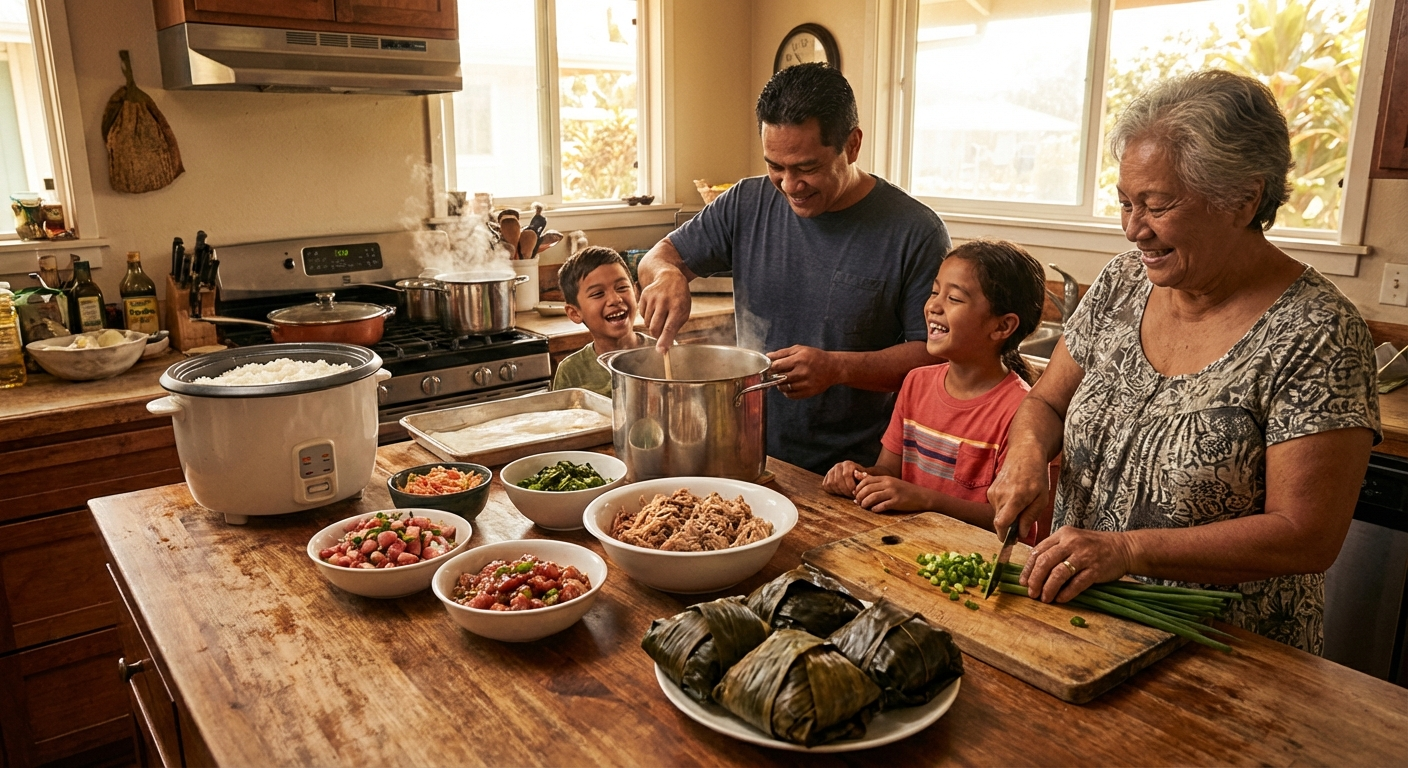
The dish I requested for every birthday. Glass noodles swimming in ginger-laced chicken broth, tender pieces of chicken, and enough green onions to make your eyes water. She made her own chicken stock from scratch, simmering bones all morning.
The secret to her chicken long rice was patience. She’d let those bones simmer low and slow for hours, skimming the foam off the top every now and then. The broth was so golden and clear, almost like liquid sunshine. And she always added the green onions at the very end — a big ol’ handful — so they stayed bright and fresh. I’ve never been able to get mine quite as good as hers, but I keep trying.
Lomi Salmon
She’d cure the salmon herself, starting days ahead. The final mix of fish, tomatoes, and onions was so fresh and bright. She always made extra because she knew I’d eat half of it before dinner.
Tutu was particular about her tomatoes for lomi salmon. They had to be firm, almost under-ripe. “Soft tomato make mushy lomi,” she’d say. And the onions — she used sweet Maui onions, diced so small they almost melted into the dish. She’d work the salmon with her hands, breaking it apart gently, mixing everything together with this careful, rhythmic motion. Lomi literally means “to massage,” and she took that seriously.
Haupia
Her coconut pudding was silky smooth, never too sweet. She taught me to use fresh coconut when possible, grating it by hand. The store-bought stuff just wasn’t the same.
Shoyu Hot Dogs
This one might sound funny, but it was my absolute favorite after-school snack. Hot dogs simmered in a mix of soy sauce, sugar, and a little ginger. So simple, so ono. She’d cut them into little coins and serve them over rice. Broke da mouth every single time. To this day, whenever I smell shoyu and sugar caramelizing together, I’m right back on that step stool.
The Wisdom She Shared
“Food is how we show love,” she told me once, pressing rice into a musubi mold. “Anyone can say words. Cooking for someone—that takes time. That takes care. That means something.”
She was right. Every meal she made carried decades of tradition, hours of preparation, and boundless love.
She also used to say, “No waste. Somebody worked hard to grow that.” Leftovers were never thrown away in Tutu’s kitchen. Yesterday’s rice became fried rice. Chicken bones became stock. Overripe bananas became banana bread. She grew up in a time when you didn’t have the luxury of waste, and that mindset never left her. It shaped how I cook today — I always find a way to use everything.
Carrying It Forward
Tutu passed five years ago, and not a week goes by that I don’t think of her when I’m cooking. I hear her voice when I season a dish. I see her hands when I fold banana leaves around lau lau.
This blog is my way of honoring her—sharing the recipes, the techniques, and most importantly, the spirit of Hawaiian cooking that she gave me.
I keep her wooden cutting board in my kitchen. It’s too worn to actually use anymore — the center is scooped out from decades of knife work — but it sits on a shelf where I can see it every day. It reminds me of where all this started. Not with a food blog or a recipe collection, but with a small kitchen, a step stool, and a grandmother who believed that the best thing you could give someone was a meal made with love.
When I teach my own kids to cook, I try to do it the way she did — hands-on, patient, no measuring cups. “Taste it,” I tell them. “Does it need more salt? You tell me.” I see her smile in those moments, and I know the tradition is alive.
Your Turn
I’d love to hear your stories. Who taught you to cook? What dishes remind you of home? Share in the comments below—let’s talk story together.
With aloha,
Curtis
E ola mau ka ‘ōlelo Hawai’i – May the Hawaiian language live forever