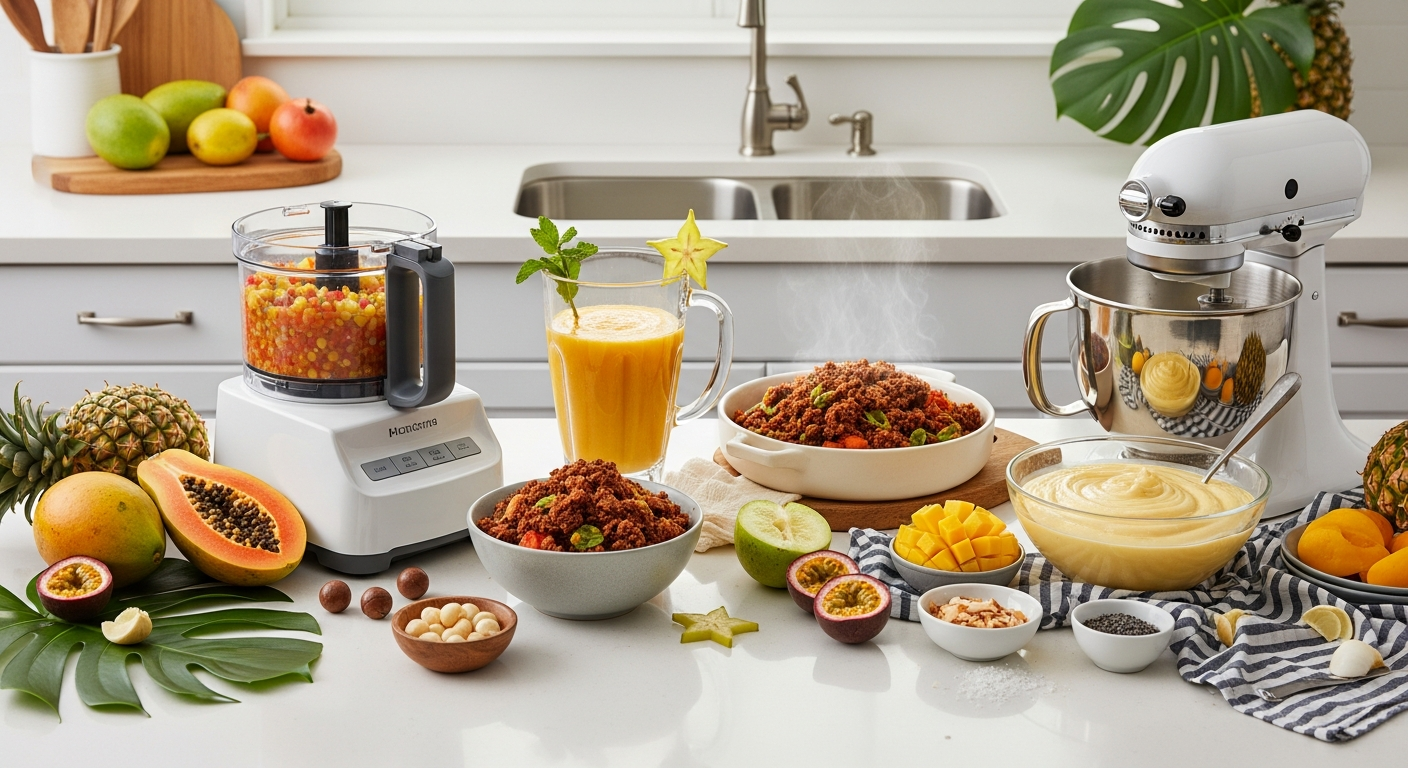
Outfitting Your Hawaiian Kitchen for Serious Cooking
Hawaiian cooking is a lot of things — comforting, generous, deeply flavorful — but “simple” isn’t always one of them. When you’re making everything from scratch the way it should be done, you need the right tools. And I’m not just talking about pots and pans. I’m talking about the appliances that sit on your counter and do the heavy lifting so you don’t have to.
Over the years, I’ve figured out which kitchen appliances actually earn their counter space in a Hawaiian kitchen and which ones just collect dust. If you’re looking to outfit your kitchen for real Hawaiian meal prep — the kind where you’re making a week’s worth of food on a Sunday or prepping for a big family gathering — these are the appliances worth investing in.
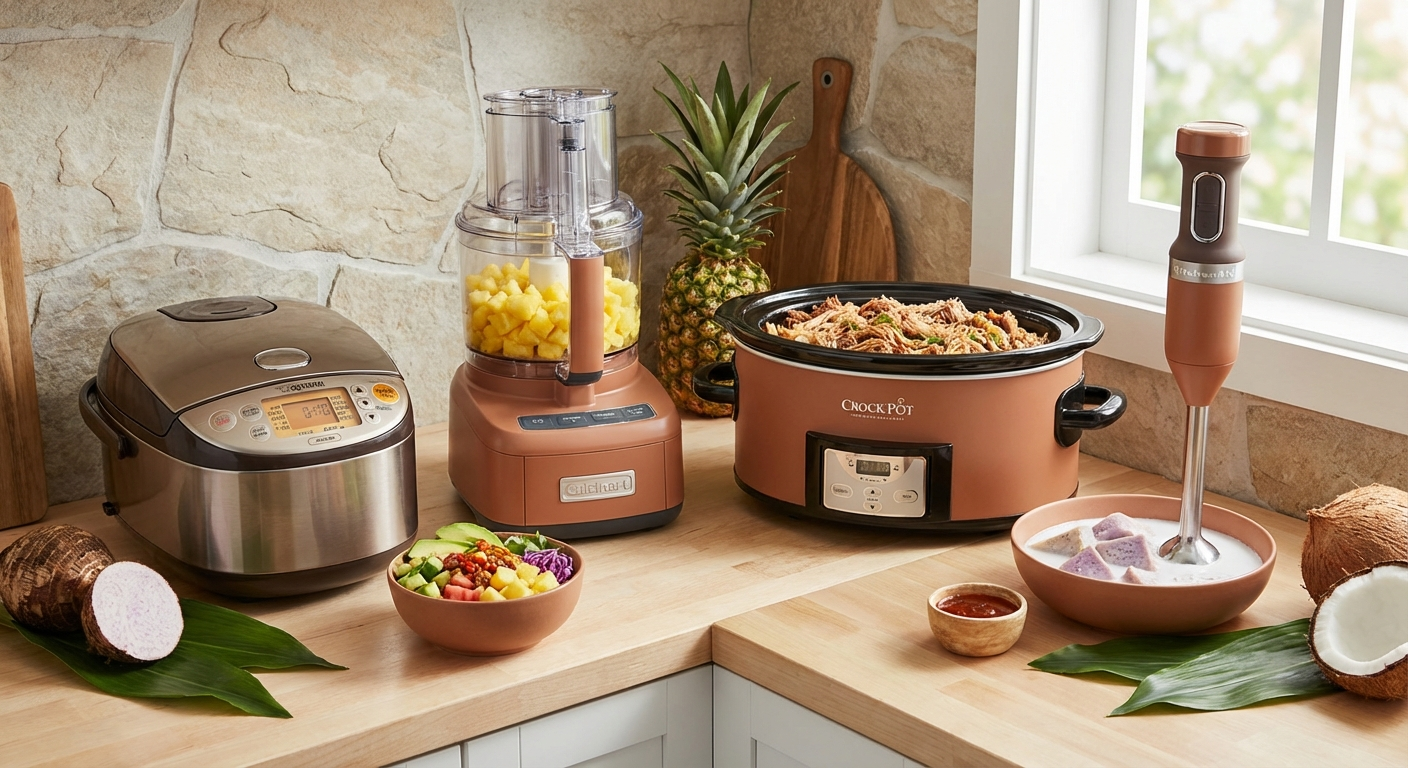
Food Processor: Your Prep Work Powerhouse
If I had to pick one appliance that saves me the most time in Hawaiian cooking, it would be the food processor. The sheer amount of chopping, mincing, and grinding that goes into our food is staggering, and a good food processor handles all of it in seconds.
Free: Hawaiian Cooking Starter Kit
Get 5 essential island recipes + a printable pantry checklist — everything you need to start cooking Hawaiian at home.
No spam, ever. Unsubscribe anytime.
Think about making inamona — that roasted kukui nut relish that goes with poke and so many other dishes. Grinding kukui nuts by hand is tedious work. A food processor pulses them into the perfect texture in about 30 seconds. Need to mince a mountain of garlic and ginger for your chicken long rice? Done in two pulses. Making kimchi or namasu for a potluck side? The slicing disc handles all that daikon and cucumber in no time.
For Hawaiian cooking, I’d recommend a full-size food processor with at least a 10-cup capacity. You want one with a strong motor that can handle nuts and dense ingredients without bogging down. The slicing and shredding disc attachments are just as useful as the standard blade, especially when you’re prepping vegetables for big batches of stir-fry or making coleslaw for plate lunches.
Stand Mixer: The Baker’s Best Friend
Hawaiian baking is its own beautiful world. Butter mochi, haupia cake, malasadas, sweet bread, mango bread, guava chiffon cake — the list goes on. If you do any amount of Hawaiian baking, a stand mixer will transform your experience.
Take butter mochi, for example. It’s one of the most beloved Hawaiian treats, and making the batter by hand means stirring mochiko flour, butter, sugar, eggs, coconut milk, and vanilla into a smooth batter. It’s doable, but it’s a workout. A stand mixer does it effortlessly and gives you a more uniform batter, which means better texture in the finished mochi.
Malasadas — those heavenly Portuguese doughnuts that are practically a Hawaiian food group — require a dough that needs good kneading. A stand mixer with a dough hook takes that labor off your hands (literally) and develops the gluten perfectly so your malasadas come out light and pillowy instead of dense.
A standard stand mixer with a 5 to 6-quart bowl is the sweet spot for home baking. It’s big enough to handle double batches of cookie dough (because you always need double batches), but not so enormous that it takes over your counter.
Blender: Beyond Smoothies
Every kitchen has a blender, but in a Hawaiian kitchen, it works overtime. Yes, it makes tropical smoothies with mango, pineapple, and lilikoi. Yes, it blends up acai bowls. But it does so much more than that.
Haupia — that silky coconut pudding that shows up at every luau and potluck — starts with blending coconut milk and cornstarch into a smooth mixture. A good blender ensures there are no lumps, which means your haupia sets up perfectly smooth and creamy. You can also use your blender for coconut-based sauces, marinades, and dressings.
If you’re into making poi at home (which is a whole project, but a rewarding one), a high-powered blender is essential for getting the right consistency. And for everyday use, blending up a quick papaya or guava smoothie for breakfast is one of life’s simple pleasures when you live in the islands — or just wish you did.
For Hawaiian cooking, I’d suggest investing in a high-powered blender rather than a basic one. The difference in performance is significant, especially when dealing with thick mixtures like haupia or frozen fruit for acai bowls. A strong motor means smoother results and a longer-lasting appliance.
Meat Grinder: For the Serious Home Cook
Now we’re getting into territory that separates the casual cooks from the dedicated ones. A meat grinder might seem like a specialty item, but if you make any of the following, it’s a game-changer: homemade Portuguese sausage, hamburger patties for loco moco, or any kind of ground meat mixture for your own sausage blends.
Homemade Portuguese sausage is in a league of its own compared to store-bought. When you grind the pork yourself, you control the fat ratio, the seasoning, the heat level — everything. You know exactly what’s going into it. And the flavor is noticeably better. If you’ve ever had homemade Portuguese sausage at someone’s house and thought “why does this taste so much better?” — they were probably grinding their own meat.
For loco moco, freshly ground beef makes a better patty. You can grind a mix of chuck and brisket for the perfect fat ratio, season it exactly how you like, and form patties that are juicier and more flavorful than anything from a pre-packaged tube of ground beef.
You don’t need a standalone meat grinder — many stand mixers have meat grinder attachments that work beautifully. That’s one more reason a stand mixer is such a smart investment for a Hawaiian kitchen. But if you grind meat frequently, a dedicated grinder with multiple plate sizes gives you more control and speed.
Dehydrator: Preserving the Old-Fashioned Way
Dehydrating food is a tradition that goes back generations in Hawai’i. Before refrigeration, drying meat and fish was how people preserved food, and some of those preserved foods became beloved staples in their own right.
Pipikaula — Hawaiian dried beef — is one of the great snacks of the islands. Making it at home with a dehydrator is straightforward: marinate thin strips of beef in soy sauce, sugar, ginger, and chili pepper, then dehydrate until chewy and intensely flavorful. It’s like beef jerky’s more sophisticated Hawaiian cousin.
Dried fish is another traditional preserved food that a dehydrator handles well. And beyond traditional preparations, a dehydrator is perfect for making dried li hing mui mango, dried pineapple, banana chips, and other tropical fruit snacks that are way better (and healthier) than anything you’d buy packaged.
For Hawaiian home cooking, a dehydrator with adjustable temperature settings and multiple trays is ideal. You’ll want at least 5 to 6 trays to make worthwhile batches — when you’re going to the trouble of marinating and slicing all that meat, you want to dehydrate enough to last a while.
Honorable Mentions
Vacuum Sealer
If you’re doing serious meal prep, a vacuum sealer is a fantastic companion to everything above. Seal your homemade Portuguese sausage, pipikaula, marinated meats, and prepped ingredients for longer freezer storage. When you cook in big batches (and in Hawaiian kitchens, we always cook big), a vacuum sealer helps you store portions properly so nothing goes to waste.
Electric Griddle
For making Spam musubi assembly-line style, cooking pancakes for a crowd, or searing teriyaki chicken for a big family dinner, an electric griddle gives you a huge, flat cooking surface that your stovetop can’t match. It’s one of those appliances you don’t think you need until you use one.
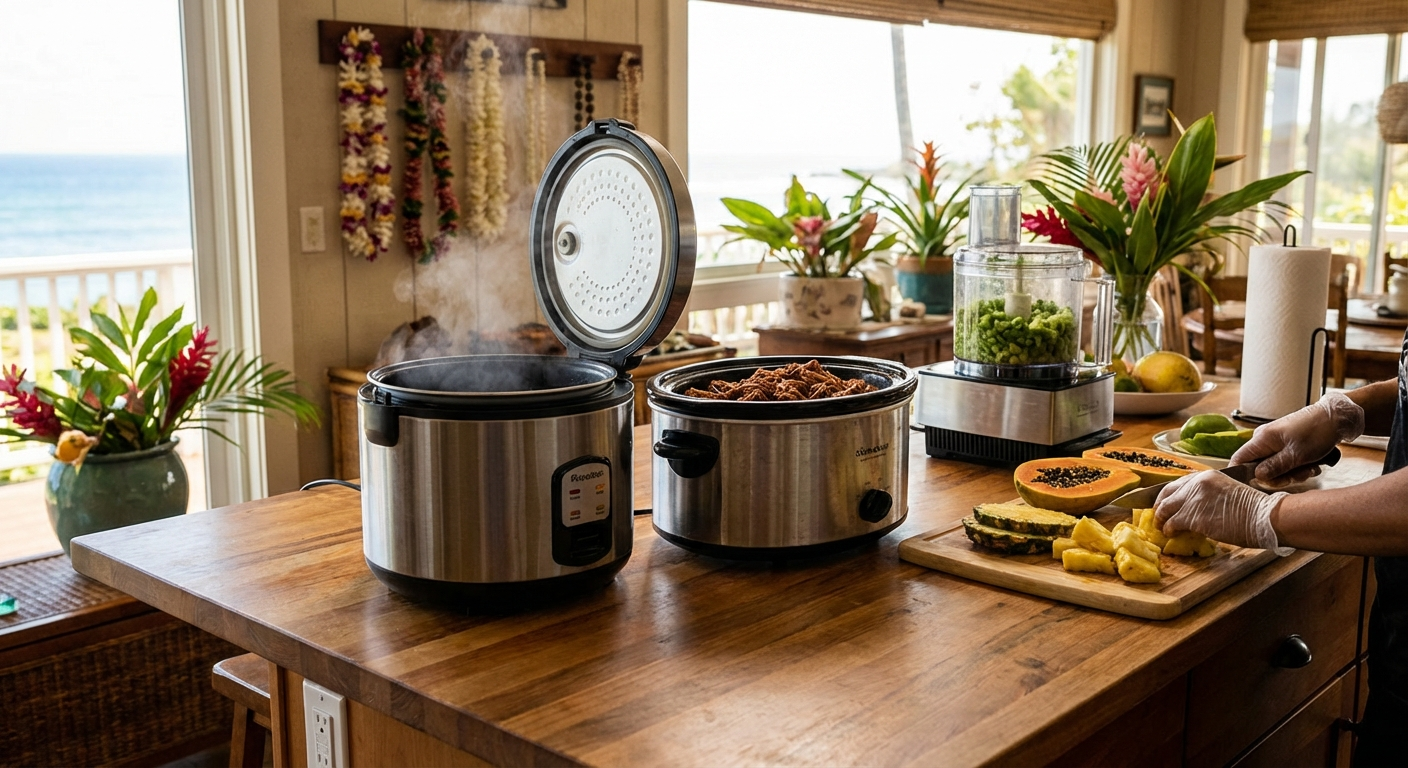
Building Your Kitchen Over Time
You don’t need to buy everything at once. If I were starting from scratch and building out a Hawaiian meal prep kitchen, here’s the order I’d prioritize:
- Blender — You’ll use it every day, from smoothies to sauces to haupia.
- Food processor — The time savings on prep work alone make this a must-have.
- Stand mixer — Essential if you bake, and the attachment options (meat grinder, pasta maker) extend its usefulness.
- Dehydrator — A fun addition that opens up a whole world of homemade preserved snacks.
- Meat grinder — The final piece for truly from-scratch Hawaiian cooking.
The beauty of Hawaiian cooking is that it’s meant to be shared. When you have the right tools in your kitchen, cooking for a crowd goes from stressful to enjoyable. And when the food comes out just right — when the Portuguese sausage is perfectly seasoned, the haupia is silky smooth, and the pipikaula is chewy and addictive — that’s when all those appliances have truly earned their place on your counter. Of course, appliances are just one part of the equation — pair them with the right essential cookware and you’ll be set for any Hawaiian meal prep session.