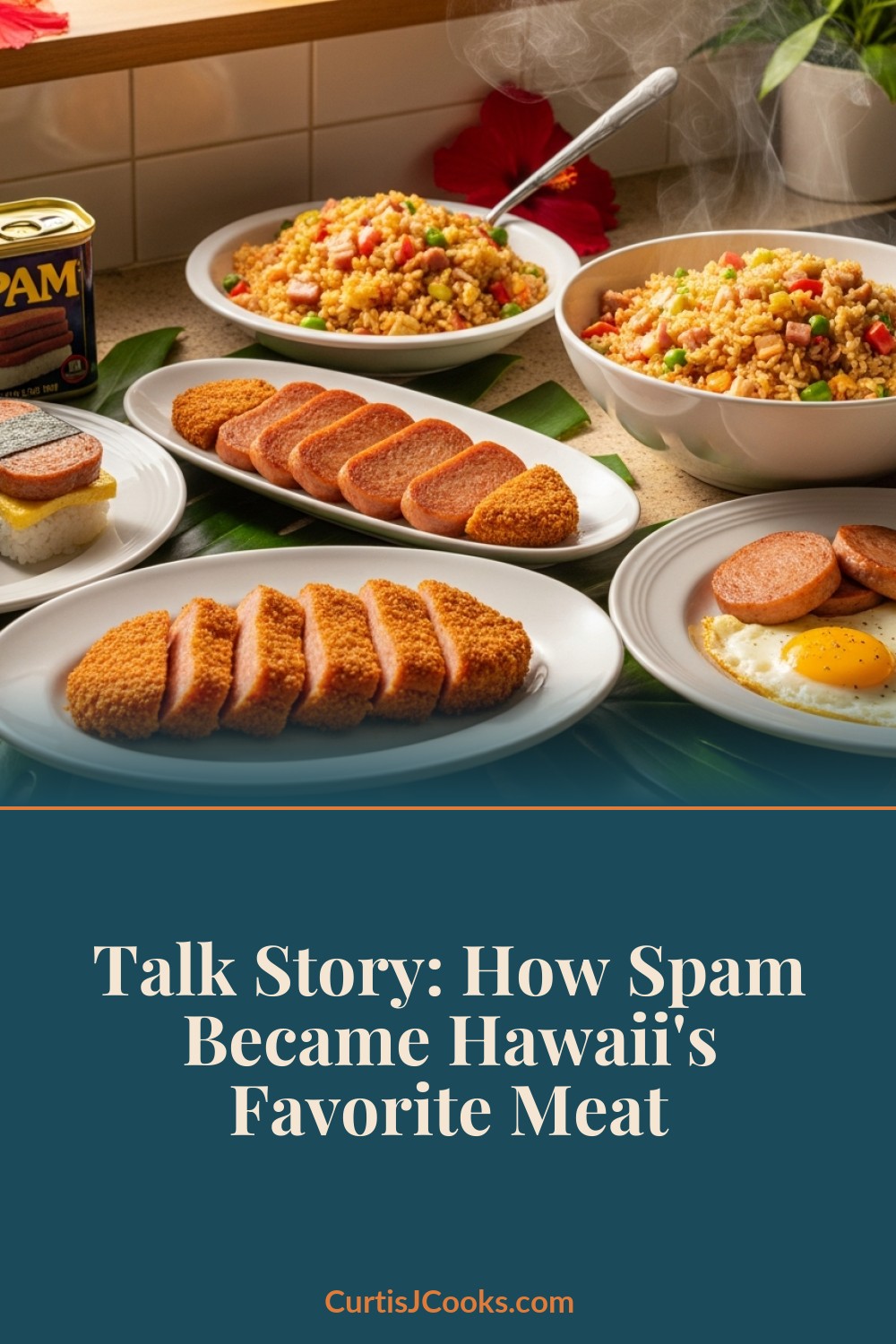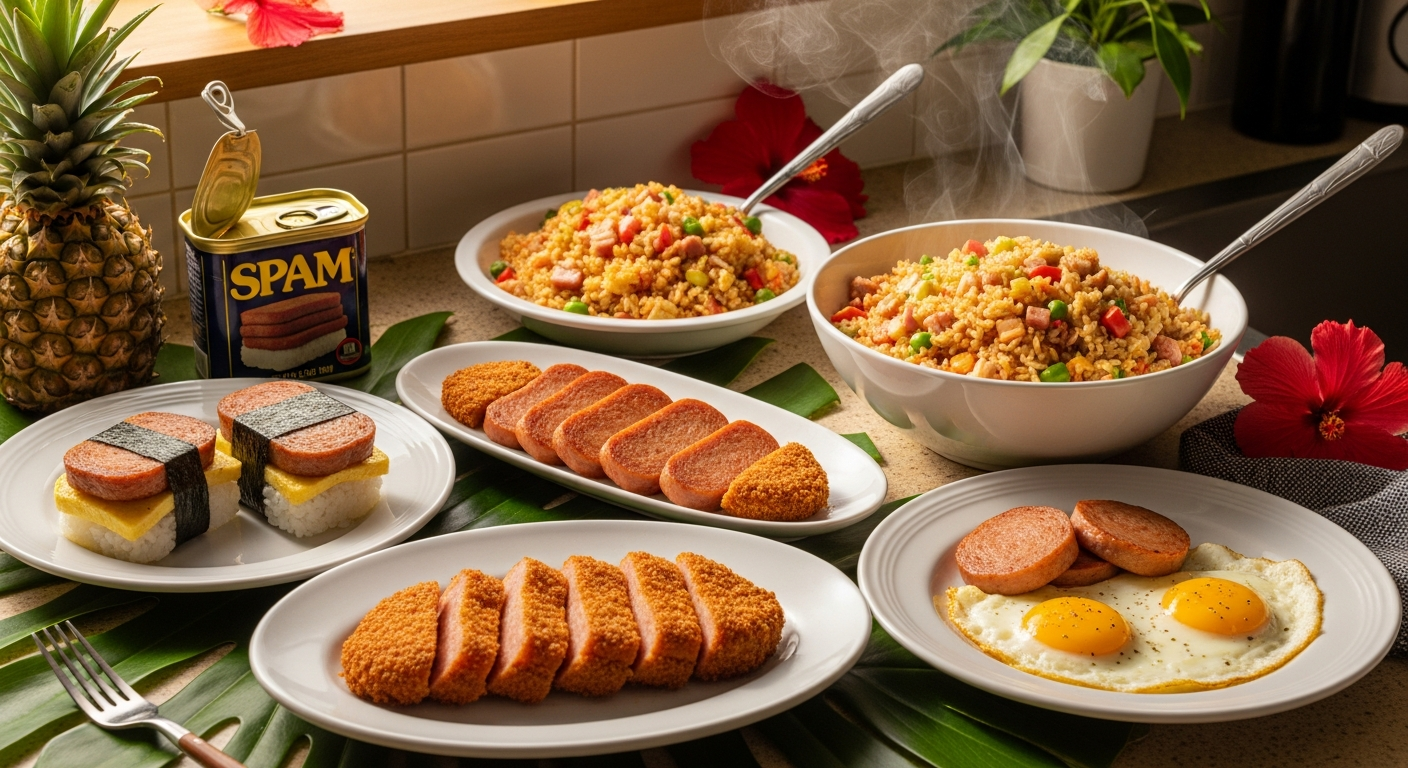
Walk into any grocery store in Hawaii and count the varieties of Spam on the shelf. Go ahead, I’ll wait. At my local Foodland, I counted fourteen last time — Classic, Less Sodium, Lite, Hickory Smoke, Black Pepper, Teriyaki, Portuguese Sausage, Tocino, Jalapeño, Hot & Spicy, Garlic, Bacon, Turkey, and whatever limited-edition flavor they’re running that month. Fourteen varieties. An entire section of the aisle devoted to a single brand of canned meat. That’s Hawaii’s relationship with Spam in a nutshell: not just acceptance, but celebration.
Hawaii consumes roughly seven million cans of Spam per year — more per capita than any other state, any other country, anywhere on earth. It’s in our breakfast plates, our bentos, our fried rice, our saimin, our sushi, our ramen. We put it in omelets and sandwiches and tacos and nachos. We wrap it in rice and nori and call it musubi, and we sell it at every gas station and convenience store on every island. When McDonald’s in Hawaii serves breakfast, there’s Spam on the menu. When there’s a natural disaster or a pandemic, Spam is the first thing to disappear from the shelves — before water, before rice, before toilet paper.
So how did a canned meat product from Austin, Minnesota become the most beloved protein in the most geographically isolated island chain on earth? Let me talk story.
Free: Hawaiian Cooking Starter Kit
Get 5 essential island recipes + a printable pantry checklist — everything you need to start cooking Hawaiian at home.
No spam, ever. Unsubscribe anytime.
Before the War: Setting the Stage
To understand why Spam took hold in Hawaii, you need to understand what the islands’ food culture looked like before World War II. Hawaii’s population was largely composed of immigrant laborers — Japanese, Chinese, Filipino, Korean, Portuguese, and Native Hawaiian families — most of whom relied on rice as a dietary staple and preserved, salted, or canned proteins to supplement fresh fish and limited livestock.
Canned goods were already a part of daily life. The plantation economy meant many families lived in remote areas without easy access to fresh meat, and canned corned beef, sardines, and other preserved proteins were common. There was already a cultural comfort with canned meat — the can itself wasn’t a barrier. Hawaii was primed for Spam before Spam even existed.
World War II: The Arrival
Spam was introduced by Hormel in 1937, and it became a military ration almost immediately. When World War II began and Hawaii became a critical military staging ground in the Pacific, millions of cans of Spam flowed through the islands. The military distributed it to troops and, during periods of food rationing and supply disruption, to the civilian population as well.
Fresh meat was scarce during the war years. Fishing was restricted in some areas for security reasons. The military’s presence meant that food supply chains prioritized military needs. For local families, Spam filled a critical gap — it was protein that was available, affordable, shelf-stable, and, importantly, it tasted good with rice. That last point is often overlooked. Spam’s salty, savory, slightly sweet flavor profile is almost perfectly designed to complement sticky white rice. It’s a pairing that works the same way that ham and bread works, or salami and pasta works — the salty protein and the starchy carb are natural partners.
After the War: Why Spam Stayed
Here’s the part that surprises people from the mainland: when the war ended and fresh meat became available again, Hawaii didn’t abandon Spam. In fact, consumption increased. Why?
Several reasons converge:
- It was already embedded in recipes. By the end of the war, families had been cooking with Spam for years. It had become part of the recipe rotation — Spam fried rice, Spam and eggs, Spam in saimin. You don’t give up a ingredient that works in a dozen dishes just because other options return.
- It fit existing culinary traditions. Japanese Americans recognized Spam as similar to kamaboko and other processed proteins in Japanese cuisine. Filipino families incorporated it alongside longganisa and tocino. Korean families treated it like a variation on budae jjigae (army stew) ingredients. Each culture had a context for Spam-like foods, which made adoption natural rather than forced.
- It was practical. Hawaii’s isolation means all food must be shipped or flown in. Canned goods have always been more reliable and affordable than fresh alternatives. Spam’s shelf stability is a genuine advantage in an island food system.
- It was affordable. For working-class families — which was most of Hawaii — Spam provided a lot of salty, satisfying protein for relatively little money.
- Nostalgia and identity. By the 1950s and 1960s, kids who had grown up eating Spam during and after the war were adults with their own families, and they fed their kids the same foods they’d loved. Spam became comfort food, then tradition, then cultural identity.
The Rise of Spam Musubi
If there’s one dish that crystallizes Hawaii’s love affair with Spam, it’s Spam musubi. This brilliant fusion — a slice of teriyaki-glazed fried Spam on a block of rice, wrapped in nori — is the single most popular grab-and-go snack in the islands. It’s in every 7-Eleven, every ABC Store, every school cafeteria, and every mom’s lunch-packing routine.
Spam musubi emerged in the 1980s, building on the Japanese onigiri tradition. Someone — Barbara Funamura of Kauai is often credited — had the idea of combining the Japanese rice ball concept with Hawaii’s favorite canned meat. The result was immediate, universal, and permanent. Today, Hawaii consumes an estimated five million Spam musubis per year, and the dish has become as iconic a symbol of local food culture as poke or plate lunch.
Spam in Local Restaurants
What really tells you about Spam’s status in Hawaii is its presence in upscale dining. This isn’t a guilty pleasure that people eat at home and deny in public. Some of Honolulu’s best restaurants incorporate Spam unapologetically:
- Chef’s tasting menus have featured deconstructed Spam musubi
- Brunch spots serve Spam eggs Benedict alongside traditional versions
- Ramen shops offer Spam as a topping option
- Food trucks build entire menus around creative Spam preparations
There’s no culinary shame around Spam in Hawaii. It occupies the same cultural space that prosciutto occupies in Italy or Vegemite occupies in Australia — it’s a processed food that transcends its industrial origins through cultural adoption and love.
The Annual Spam Jam
Every year, Waikiki shuts down a stretch of Kalakaua Avenue for the Spam Jam, a street festival celebrating all things Spam. Local restaurants compete with creative Spam dishes — Spam katsu, Spam sliders, Spam tacos, Spam poke bowls, Spam desserts. Tens of thousands of people attend. There’s live music and entertainment. Corporate Hormel sends representatives, presumably in a state of grateful disbelief that their canned meat product inspires a street festival in paradise.
The Spam Jam is joyful and slightly absurd and completely sincere, which is the most Hawaiian combination of qualities I can think of. We know it’s canned meat. We don’t care. We love it. We throw a party for it. That’s aloha spirit applied to a shelf-stable pork product, and it works.
The Mainland Divide
Mainlanders often make jokes about Hawaii’s Spam obsession, and I get it — from the outside, it seems weird. The mainland relationship with Spam is colored by decades of jokes, Monty Python sketches, and a general sense that canned meat is somehow shameful, the food of last resort.
But here’s what the mainland misses: context is everything in food. The French eat snails. The Japanese eat fermented soybeans. The Scots eat haggis. Every food culture has ingredients that outsiders find strange but insiders find essential. Spam in Hawaii isn’t strange — it’s foundational. It’s not what you eat when you can’t afford anything else. It’s what you eat because it’s good, because it’s yours, because your mom made it this way and her mom made it this way and you’ll make it this way for your kids.
So before you make a Spam joke to a local, maybe try a Spam musubi first. Eat it warm, with the teriyaki glaze still sticky on your fingers. Then tell me it’s not one of the most satisfying bites of food you’ve ever had. I’ll wait.
Make It Yourself
Ready to experience Hawaii’s Spam love firsthand? Start with our Spam Musubi recipe — the gateway to understanding what all the fuss is about. Once you’ve nailed the classic, try our Bacon Avocado Spam Musubi for a modern twist with crispy bacon and creamy avocado. From there, try adding Spam to fried rice, scrambled eggs, or even ramen. You might just convert.