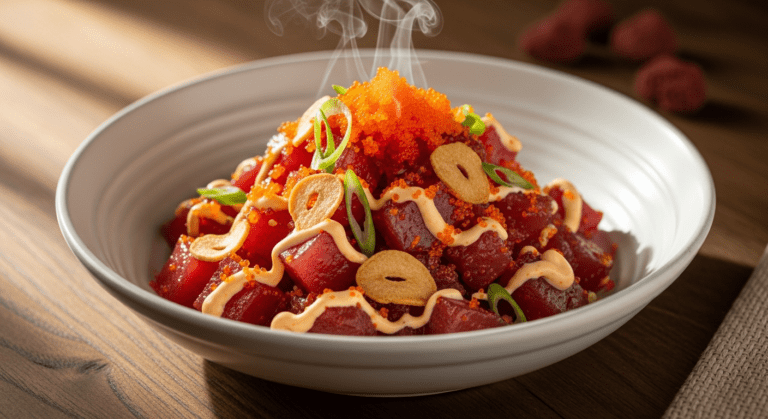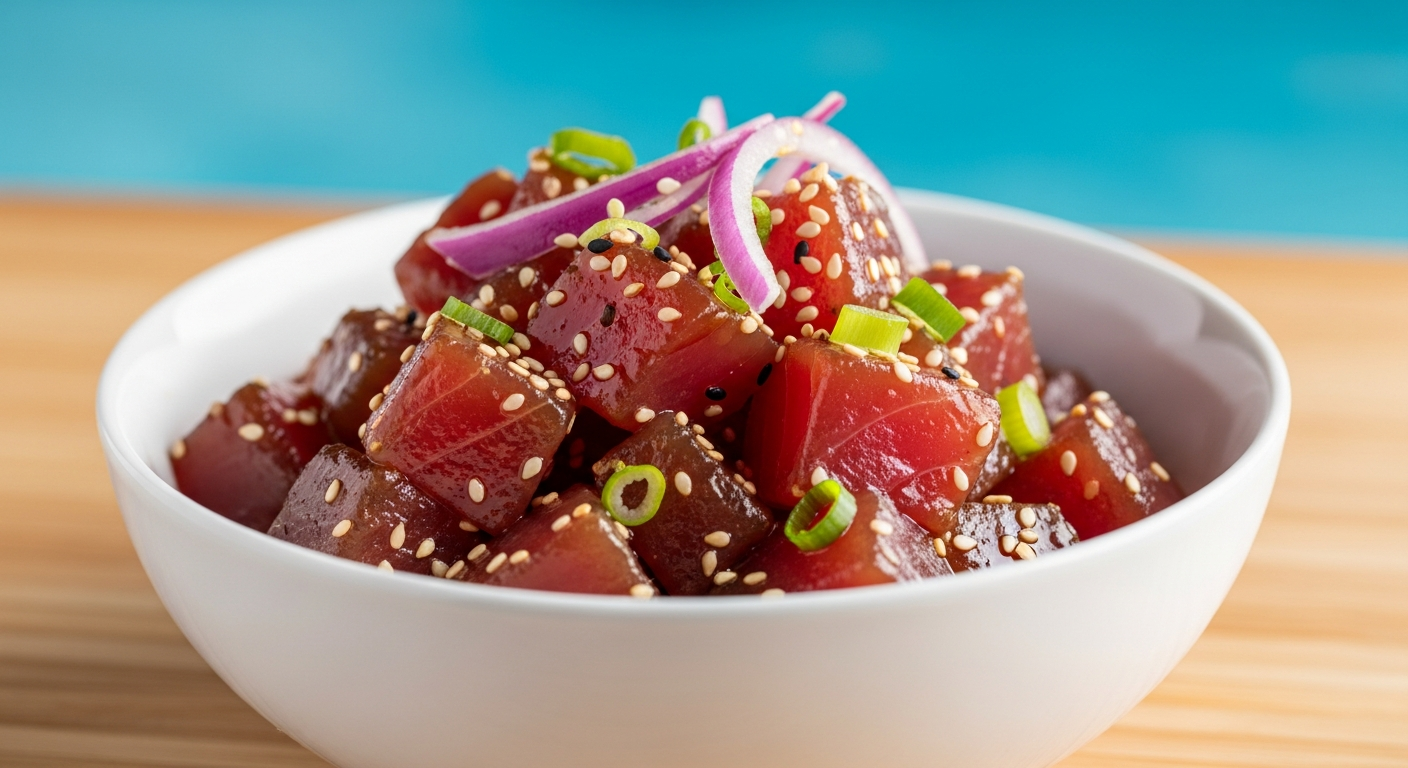
If you’ve eaten poke in the last five years, there’s a good chance you ate it at a mainland chain where you stood in line like you were at Chipotle, pointed at a dozen toppings behind glass, and received a bowl piled so high with avocado, mango, crispy onions, sriracha mayo, and edamame that you could barely find the fish underneath. And it was probably fine. Maybe even good. But I need you to understand something: that’s not poke. That’s a salad with fish in it.
Real poke — the poke that Hawaiian fishermen have been eating for centuries, the poke that sits in metal trays behind the counter at Foodland, the poke that every local family buys by the pound for parties and eats standing up in the kitchen before the guests arrive — is a fundamentally different thing. It’s simpler, it’s more focused, and it’s about the fish. Everything else is supporting cast.
Let me talk story about where poke came from, what it actually is, and why it matters that we get it right.
Free: Hawaiian Cooking Starter Kit
Get 5 essential island recipes + a printable pantry checklist — everything you need to start cooking Hawaiian at home.
No spam, ever. Unsubscribe anytime.
Ancient Origins
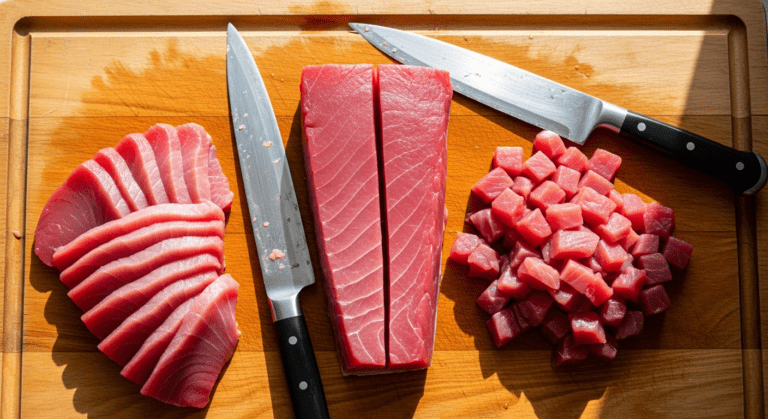
The word poke (pronounced “po-KAY”) means “to slice” or “to cut crosswise” in Hawaiian. In its oldest form, poke was simply raw reef fish cut into pieces and seasoned with whatever was available — sea salt, seaweed (limu), crushed kukui nut (candlenut), and chili pepper. It was fisherman’s food, prepared on the boat or the shore, eaten with the fingers, and requiring nothing more than a sharp knife and fresh catch.
This pre-contact version of poke — sometimes called “Hawaiian-style poke” to distinguish it from the soy-sauce-based versions that came later — is still made and eaten today. At its best, it’s a revelation: the pure, clean flavor of incredibly fresh fish enhanced by the briny crunch of limu and the rich, earthy nuttiness of kukui. No soy sauce, no sesame oil. Just fish, salt, seaweed, and nuts. If you ever get the chance to try it, don’t pass it up.
The Evolution
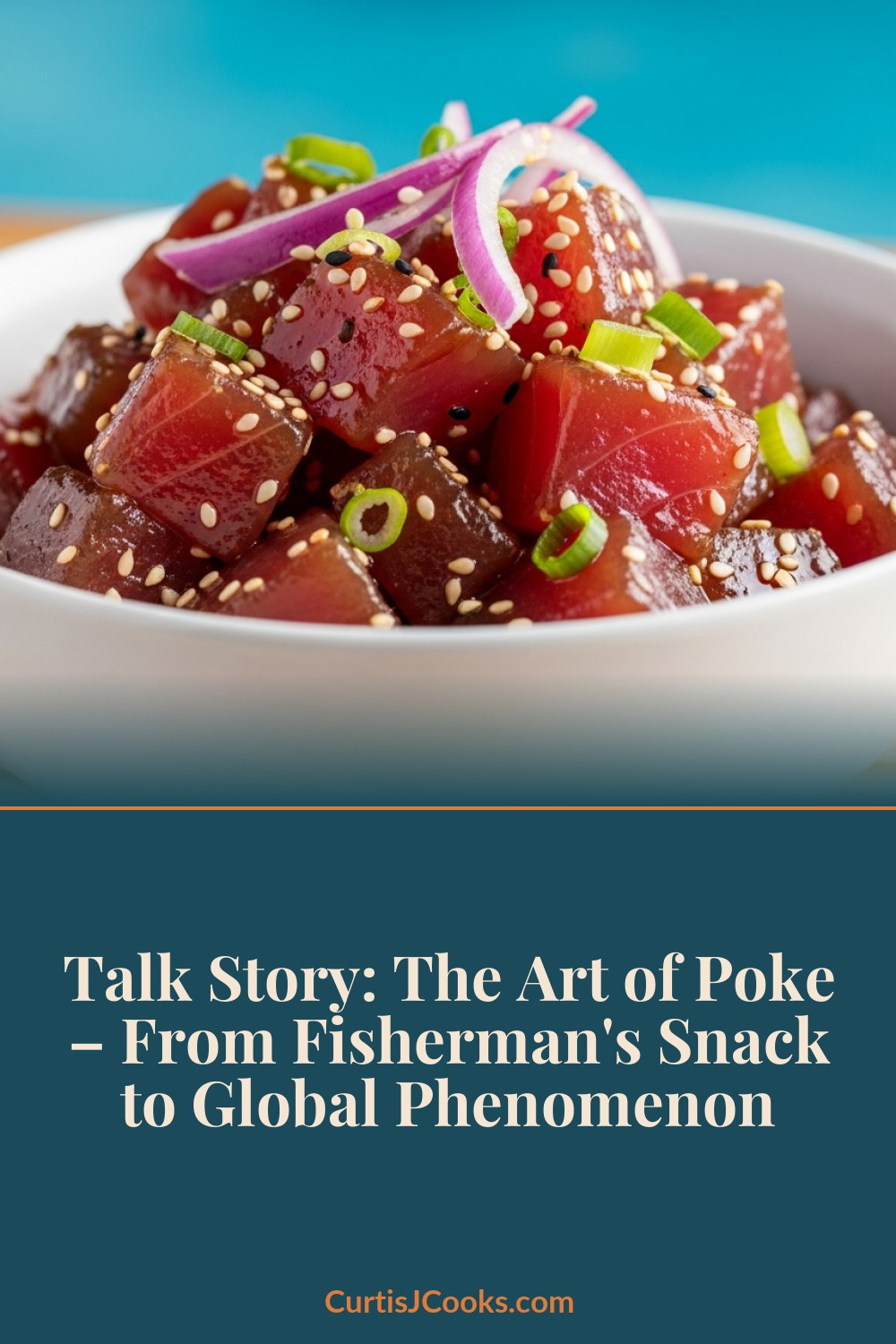
Poke began to change as Hawaii’s population diversified. Japanese immigrants brought soy sauce and sesame oil, and these flavors merged with the existing Hawaiian preparation to create what’s now the most popular style: shoyu poke. Cubed ahi tossed with soy sauce, sesame oil, green onions, and sliced sweet onion. This version became the standard at fish counters across Hawaii and remains the default when someone says “poke” without further qualification.
Korean influences added gochujang and chili flakes to some preparations. Chinese flavors contributed five-spice and oyster sauce. Filipino, Japanese, and other culinary traditions contributed their own variations. Poke became, like so many Hawaiian foods, a multicultural collaboration — ancient Hawaiian at its core, with layers of flavor added by every culture that called the islands home.
By the late 20th century, poke was firmly established as one of Hawaii’s signature foods, available at every grocery store, fish market, and casual restaurant. The fish counter at any Foodland, Safeway, or Times supermarket in Hawaii offers a dozen varieties of poke daily, and buying a pound of poke on the way home from work is as routine as picking up a gallon of milk.
The Fish Counter Experience
If you’ve never bought poke at a Hawaiian fish counter, here’s what it looks like: a long refrigerated case with metal trays of different poke preparations, each labeled with the type of fish and style. You might see:
- Shoyu ahi poke — the classic soy sauce and sesame version
- Spicy ahi poke — with chili flakes, sriracha, or sambal
- Hawaiian-style ahi — with limu and kukui nut, no soy
- Limu ahi poke — heavy on the seaweed
- Wasabi ahi poke — for those who like heat
- Tako (octopus) poke — tender octopus in sesame soy
- Salmon poke — not traditional but popular
- Tofu poke — the vegetarian option, surprisingly good
You order by the pound or half-pound, the person behind the counter scoops it into a plastic container, and you eat it however you want — over rice, with poi, on crackers, or straight out of the container with a fork while standing in the parking lot. That last option is more common than anyone admits.
The best fish counters in Hawaii are worth knowing about. Foodland’s poke selection is consistently excellent and widely considered the best supermarket poke in the state. Tamashiro Market on North King Street in Honolulu has been a poke institution for decades. Ono Seafood in Kapahulu is tiny, cash-only, and makes some of the best poke on O’ahu. Fort Ruger Market in Kaimuki is a hidden gem. On the Big Island, Suisan Fish Market in Hilo is legendary.
The Mainland Poke Boom
Around 2015, poke exploded on the mainland. Seemingly overnight, poke bowl shops appeared in every major city, from New York to Los Angeles to Chicago. The concept was adapted to a fast-casual format: choose your base (rice, greens, or chips), choose your protein, choose your sauce, pile on the toppings. Assembly-line poke.
Some of these places are good. The fish is fresh, the sauces are well-made, and the concept works for a quick, healthy lunch. But the mainland poke bowl trend has also drifted far from the Hawaiian original in ways that are worth noting:
- The toppings overwhelm the fish. In Hawaii, poke is about the fish. On the mainland, the fish is often just one of fifteen things in a bowl. When your poke bowl has more avocado than ahi, the priorities have shifted.
- The sauces are heavy. Sriracha mayo, ponzu aioli, spicy mayo, “volcano sauce” — these aren’t poke seasonings. They’re condiments that mask the flavor of the fish rather than enhancing it.
- The cultural context is missing. Many mainland poke chains have no connection to Hawaii, no Hawaiian employees, no understanding of the food’s cultural significance. Some don’t even pronounce the name correctly. This matters less for the food quality but it matters for cultural respect.
I don’t want to be a purist about this. Food travels, food evolves, and if a poke bowl chain in Denver introduces someone to the concept and they eventually seek out the real thing — that’s a win. But I do think it’s important to understand what poke actually is before you start “improving” it. You have to know the rules before you break them.
Making Poke at Home
The good news is that real poke is incredibly easy to make at home, and it’s actually simpler than the mainland bowl-shop version because you need fewer ingredients. Fresh sushi-grade ahi, soy sauce, sesame oil, sweet onion, and green onions. That’s the whole recipe. Check out our Ahi Poke Bowl recipe for the full instructions, our Ahi Tuna Poke Stacks for an elegant layered presentation, or our Gourmet Poke Bowl for a next-level bowl with eel, spicy salmon, and mango.
The hard part — the only hard part — is finding great fish. If you can get your hands on sushi-grade ahi, the rest takes five minutes and a sharp knife. If you can’t find good fish, don’t make poke. No amount of soy sauce and sesame oil will fix mediocre fish. The fish is the dish.
The Poke Rules
I don’t like being prescriptive about food. Cook what you want, eat what you like, add mango to your poke if that makes you happy. But if you want to make poke the way it’s made in Hawaii — the way it’s been made for generations — here are the principles:
- Start with great fish. This is the only rule that really matters. Everything else is negotiable if the fish is perfect.
- Keep it simple. The best poke has 4-6 ingredients including the fish. If your ingredient list is longer than that, you’re making a salad, not poke.
- Season to enhance, not mask. The soy sauce and sesame oil should make the fish taste more like itself, not less.
- Eat it fresh. Poke is best within minutes of mixing. The acid in the soy sauce starts to “cook” the fish the longer it sits.
- Respect the origin. Poke is Hawaiian. It has a history, a culture, and a meaning beyond “raw fish bowl.” You don’t have to make it the old way every time, but knowing where it comes from matters.
Why It Matters
Poke matters because it’s one of the purest expressions of Hawaiian food philosophy: take what the land and sea provide, treat it with respect, keep it simple, share it with people you love. There’s no fancy technique in poke. There’s no expensive equipment. There’s just a fisherman, a knife, and the ocean. Everything else grew from that.
When you make poke at home — even on the mainland, even with fish you bought at a grocery store — you’re participating in a tradition that stretches back centuries. You’re connecting to a food culture that values freshness over fussiness, simplicity over spectacle, and sharing over showing off. That’s worth preserving, and it’s worth getting right.