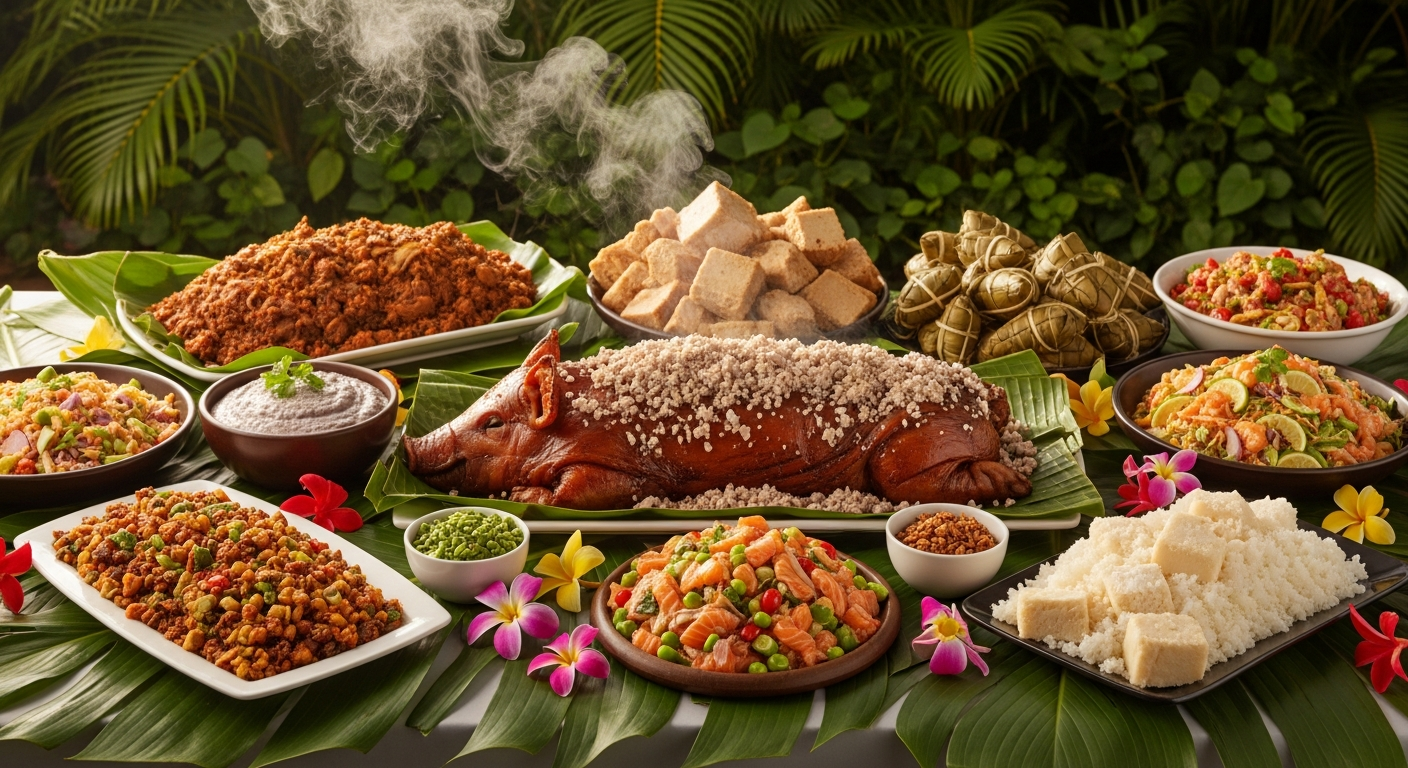
The word “luau” conjures a specific image for most people: tiki torches, grass skirts, a roast pig on a platter, hula dancers, and a mai tai in hand. It’s one of the most recognizable cultural exports from Hawaii — right up there with surfing, aloha shirts, and ukulele music. But like a lot of things that become tourist attractions, the commercial luau you attend at a resort bears only a passing resemblance to the real thing. The real luau is older, deeper, and more meaningful than any $150-a-plate dinner show can capture.
Let me talk story about the luau — where it came from, what it really means, and why the food at the center of it matters so much.
The Ancient Feast: ‘Aha’aina
The luau as we know it evolved from the ‘aha’aina, a traditional Hawaiian feast that dates back to ancient Polynesian culture. The ‘aha’aina was a sacred gathering — a celebration of significant events like the birth of a child, the completion of a canoe, a military victory, the naming of a chief, or the harvest season. Food was central to the celebration, but the feast was as much a spiritual and social event as a culinary one.
Free: Hawaiian Cooking Starter Kit
Get 5 essential island recipes + a printable pantry checklist — everything you need to start cooking Hawaiian at home.
No spam, ever. Unsubscribe anytime.
In ancient Hawaii, the ‘aha’aina was governed by the kapu system — a strict set of religious and social laws that dictated, among many other things, who could eat what, when, and with whom. Men and women ate separately. Certain foods — including pork, certain fish, coconuts, and bananas — were forbidden to women. The feast was a ritually significant occasion, and the preparation and serving of food was guided by protocol and prayer.
The food at an ancient ‘aha’aina would have included kalua pig cooked in the imu, poi pounded from taro, raw and cooked fish, sweet potatoes, breadfruit, seaweed, and coconut. These were the foods of the land and sea — the ‘aina — and eating them together was an act of connection to the earth, the gods, and each other.
Breaking the Kapu
In 1819, a pivotal event changed Hawaiian dining forever. King Kamehameha II (Liholiho), encouraged by Queen Ka’ahumanu, publicly broke the eating kapu by sitting down to eat with women at a feast. This act of ‘ai noa — free eating — effectively abolished the kapu system and its strict rules about gender-segregated dining and food taboos.
The ‘ai noa was a revolutionary moment in Hawaiian history, and it transformed the Hawaiian feast from a ritually regulated event into a more open, inclusive celebration. Men and women could now eat together, share the same foods, and enjoy the communal experience of a feast without the restrictions of the old system. The modern luau was born from this moment of liberation.
Why “Luau”?
The name “luau” actually comes from a dish, not the event itself. Lu’au refers to the young taro leaf tops that are a key ingredient in several traditional Hawaiian dishes, including chicken lu’au (chicken cooked with taro leaves and coconut milk) and squid lu’au. By the mid-1800s, the word had expanded to refer to the entire feast where these dishes were served. The food named the party — which tells you everything about how central food is to Hawaiian celebration.
The Foods of the Luau
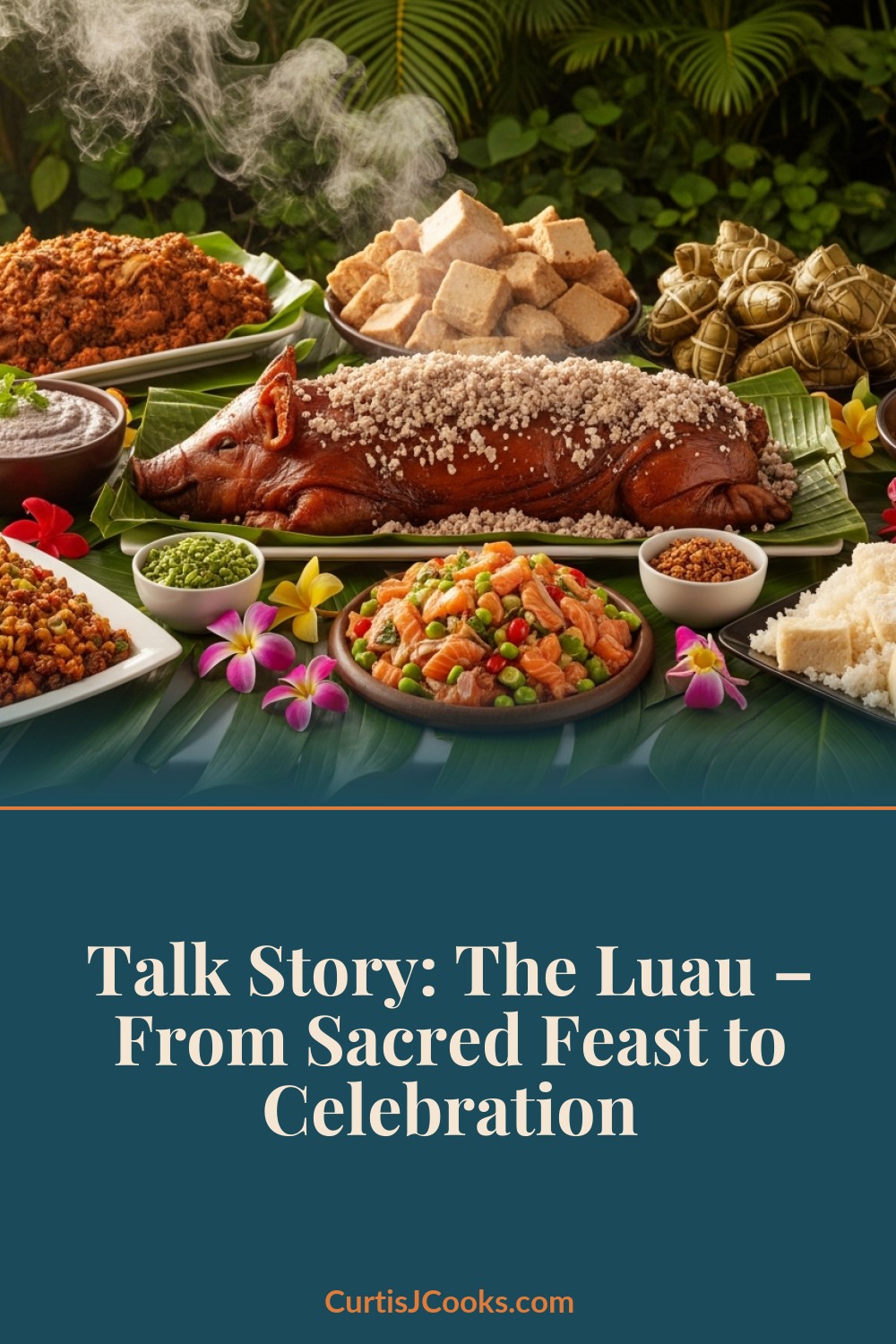
A traditional Hawaiian luau centers on a specific set of dishes, each with its own cultural significance:
Kalua Pig
The centerpiece. A whole pig, cooked in the underground imu oven for 8-12 hours until smoky and fall-apart tender. The unveiling of the pig from the imu is often the ceremonial highlight of the luau — the moment when the earth is opened and the food is revealed. Our Kalua Pig recipe gives you a home-friendly version of this foundational dish.
Poi
Pounded taro root, mixed with water to the desired consistency. Poi is the most culturally significant food in Hawaii — taro (kalo) is considered the elder sibling of the Hawaiian people in the creation story, and eating poi is an act of connection to ancestry and land. At a luau, poi is always present, usually in a communal bowl. The consistency ranges from “one-finger poi” (thick, you can eat it with one finger) to “three-finger poi” (thin, requiring three fingers to scoop).
Laulau
Pork and butterfish wrapped in taro leaves and ti leaves, steamed until meltingly tender. Our Laulau recipe teaches you this ancient preparation. Laulau represents the Hawaiian philosophy of using every part of the taro plant — the root becomes poi, the leaves wrap the meat.
Lomi Lomi Salmon
Salt-cured salmon hand-massaged with tomatoes and sweet onion. This bright, fresh side dish is a perfect counterpoint to the rich pork dishes. Our Lomi Lomi Salmon recipe captures the traditional preparation.
Chicken Long Rice
Chicken and glass noodles (bean thread noodles) in a ginger-infused broth — a dish that shows the Chinese influence on Hawaiian cuisine. The name is misleading — there’s no rice, and the “long rice” is actually mung bean noodles. It’s a comforting, soupy dish that’s always welcome at the luau table.
Poke
Raw ahi tuna in various preparations — shoyu, Hawaiian-style with limu, or spicy. Poke represents the sea at the feast, balancing the land-based proteins with the fresh flavors of the ocean. Read our Talk Story: The Art of Poke for the full history.
Haupia
Coconut pudding, firm enough to cut into squares. Haupia is the traditional dessert of the luau — smooth, subtly sweet, and made from just coconut milk, sugar, and cornstarch (or traditionally, arrowroot). It’s the perfect ending to a rich meal.
Squid Lu’au
Squid cooked with taro leaves and coconut milk — one of the dishes that gave the feast its name. Rich, creamy, and deeply traditional. Our Squid Lu’au recipe captures this essential dish.
The Modern Luau
Today’s luaus exist on a spectrum. At one end, there are the commercial tourist luaus — large-scale productions at resorts and cultural centers that serve hundreds of guests a buffet dinner with hula performances, fire dancing, and cultural demonstrations. These range from genuinely respectful celebrations of Hawaiian culture (the Smiths’ Luau on Kauai and the Old Lahaina Luau on Maui are widely considered the best) to cheesy tourist traps that treat Hawaiian culture as a theme park.
At the other end, there are family luaus — private celebrations held in backyards, parks, and beach pavilions for birthdays, graduations, baby’s first birthday (a huge deal in Hawaiian culture), weddings, and family reunions. These are the real luaus, and they look nothing like the tourist version. There’s no stage, no fire dancers, no admission fee. There’s an uncle tending the imu since dawn. There are aunties in the kitchen preparing lomi lomi salmon and chicken long rice. There are coolers full of beer and juice. There are kids running around. And there’s a table — usually multiple folding tables pushed together and covered in aluminum foil — loaded with every dish I’ve described above, plus rice, mac salad, cake, and whatever else people brought.
The family luau is one of the most beautiful expressions of Hawaiian culture. The food is prepared communally — everyone contributes a dish or helps with the cooking. The eating is communal — everyone sits together, eats together, and shares. The celebration is communal — it’s not about performance or entertainment, it’s about being together. This is the spirit of the ‘aha’aina, alive and well in modern Hawaii.
How to Host Your Own Luau
You don’t need to be in Hawaii or Hawaiian to host a luau-inspired gathering. The spirit of the luau — generous food, shared preparation, communal eating, celebration of people and place — translates anywhere. For a practical guide on planning the menu and pulling it all together, check out our How to Throw a Hawaiian Backyard Party guide.
The key is respect. If you’re hosting a Hawaiian-themed gathering, treat the culture with the same respect you’d want for your own. Learn about the foods you’re making. Understand their significance. Don’t reduce Hawaiian culture to tiki torches and plastic leis. The real beauty of the luau is the values it embodies: generosity, community, connection to the land, and the belief that sharing food is one of the most meaningful things people can do together.
That belief didn’t start in 2026. It started centuries ago, around an earthen oven on a Pacific island, with a whole pig buried under leaves and a community gathered to eat. The details have changed, but the spirit hasn’t. That’s the luau.