If you grew up in Hawaii, oxtail soup means Sunday. It means waking up to the sound of a stockpot bubbling, the smell of star anise and ginger filling the house, and knowing that in a few hours you’d be sitting down to one of the most deeply satisfying bowls of food on the planet. This isn’t a quick weeknight meal — it’s a ritual, a labor of love that rewards your patience with rich, beefy broth and fall-off-the-bone tender meat.
Hawaiian oxtail soup traces its roots to the Chinese immigrants who came to work Hawaii’s sugar plantations in the 1800s. They brought their tradition of slow-simmered bone broths and adapted it with what was available — oxtails that were cheap and plentiful, local ginger, and whatever greens grew nearby. Over generations, the dish became a cornerstone of local food culture, served at hole-in-the-wall restaurants and family tables alike.
What makes Hawaiian oxtail soup different from other oxtail preparations is the broth. It’s clear, not murky. It’s aromatic from star anise and dried orange peel, not heavy with tomato or wine. And the experience of eating it — dipping the tender meat in a soy-mustard sauce, slurping the broth over rice, crunching on peanuts — is uniquely, unmistakably Hawaii.
Free: Hawaiian Cooking Starter Kit
Get 5 essential island recipes + a printable pantry checklist — everything you need to start cooking Hawaiian at home.
No spam, ever. Unsubscribe anytime.
Why the Broth Has to Be Clear
A good oxtail soup is judged by its broth. It should be golden, clean, and completely see-through — you should be able to see the bottom of the bowl. This clarity comes from one crucial step: blanching. Before you start the real cooking, the oxtails need a hard boil for about 10 minutes. This draws out the scum, blood, and impurities. You drain everything, rinse the oxtails and the pot, then start fresh with clean water. Skip this step, and your broth will be cloudy and murky no matter how long you simmer.
The other secret is patience. Once you start the real simmer, you never let it boil hard again. A gentle, barely-bubbling simmer for 3 hours is what extracts all that collagen and flavor without breaking the broth. Skim any foam that rises during the first 30 minutes, then leave it alone.
Ingredients You’ll Need
Oxtail soup is simple by nature. The magic is in the quality of ingredients and the time you give them.
- 3-4 pounds oxtails — ask your butcher for pieces cut about 2 inches thick. Look for a good ratio of meat to bone.
- 3-inch piece fresh ginger — sliced into thick coins, skin on. Don’t mince it — you want big pieces you can fish out later.
- 4 whole star anise — the signature aromatic. This is what makes it taste like Hawaii.
- 1 piece dried orange peel (or fresh peel from half an orange) — a subtle citrus note that rounds everything out.
- 1 cinnamon stick — optional, but traditional in many families’ recipes.
- 1 tablespoon whole black peppercorns
- 2 tablespoons Hawaiian sea salt (or to taste)
- 1 bunch mustard cabbage (gai choy) — washed and cut into 2-inch pieces. This is non-negotiable.
- 1/2 cup raw peanuts — optional, but deeply traditional. They cook in the broth and become soft and savory.
- Cilantro, green onions — for garnish
- 12 cups water (for the main simmer)
Step-by-Step: Hawaiian Oxtail Soup
Step 1: Blanch the Oxtails
Place the oxtails in a large stockpot and cover with cold water. Bring to a rolling boil over high heat and let it boil hard for 10 minutes. You’ll see a huge amount of foam and scum rise to the surface — that’s exactly what you want out of your final broth. Drain everything, rinse the oxtails under cold running water, and scrub the pot clean. This single step is the difference between restaurant-quality clear broth and murky soup.
Step 2: Build the Broth
Return the clean oxtails to the clean pot. Add 12 cups of fresh cold water, the ginger coins, star anise, dried orange peel, cinnamon stick (if using), peppercorns, and raw peanuts (if using). Bring to a boil over high heat, then immediately reduce to a bare simmer — you want just the occasional bubble breaking the surface. Skim any foam that appears in the first 30 minutes.
Step 3: The Long Simmer
Cover the pot with the lid slightly ajar and let it simmer for 2.5 to 3 hours. You’ll know it’s done when the meat is pulling away from the bone and a chopstick slides through the thickest piece with zero resistance. The broth should be golden and aromatic. Resist the urge to crank up the heat — low and slow is the only way.
Step 4: Season and Add the Greens
Season the broth with Hawaiian sea salt — start with 2 tablespoons and adjust. Fish out the star anise, ginger, orange peel, and cinnamon stick if you’d like a cleaner presentation (or leave them — many families do). Add the mustard cabbage pieces to the pot and simmer for another 5-8 minutes until the greens are tender but still have a slight bite. Mustard cabbage should be a little bitter — that’s the point. It cuts through the richness of the broth.
Step 5: Serve Local Style
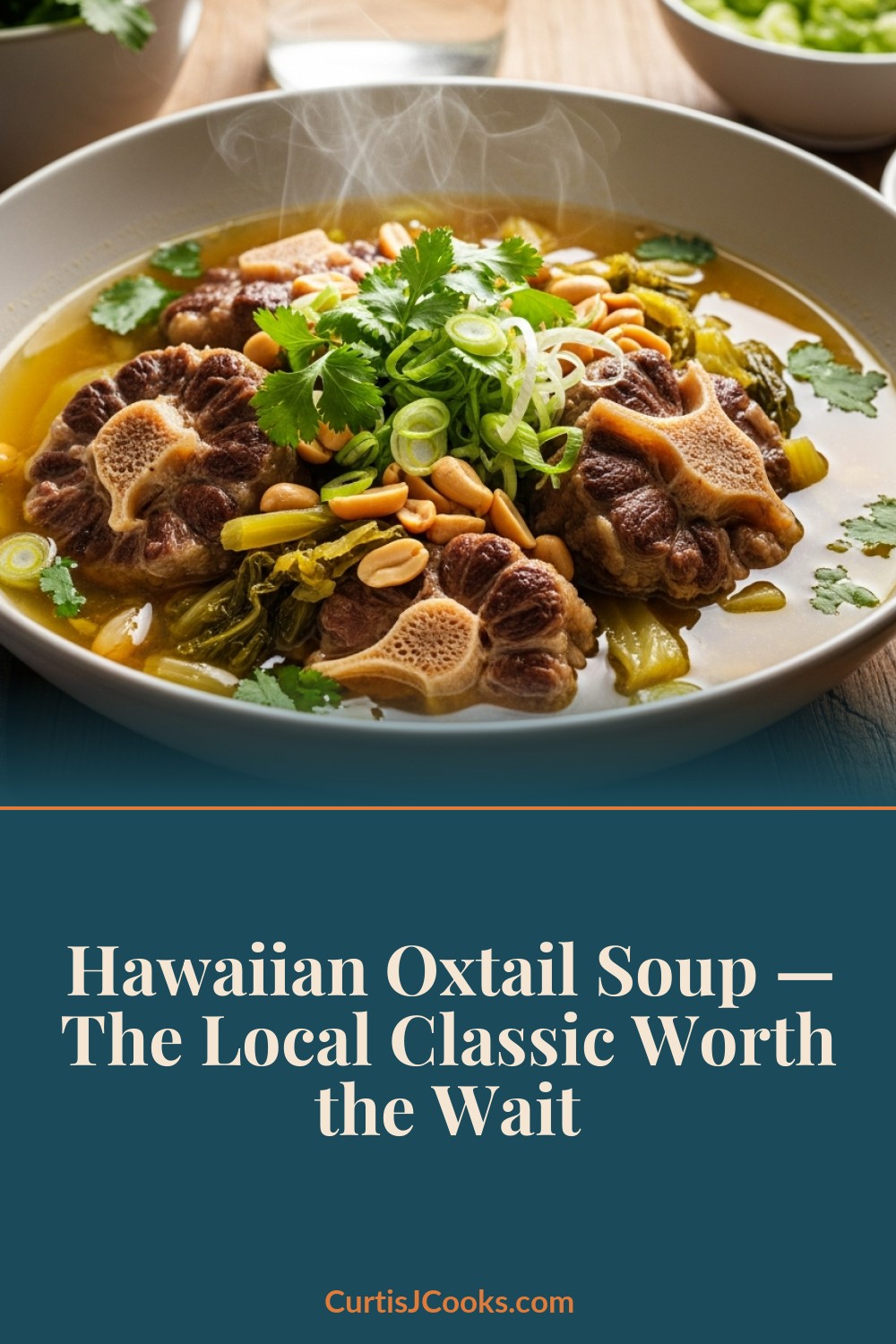
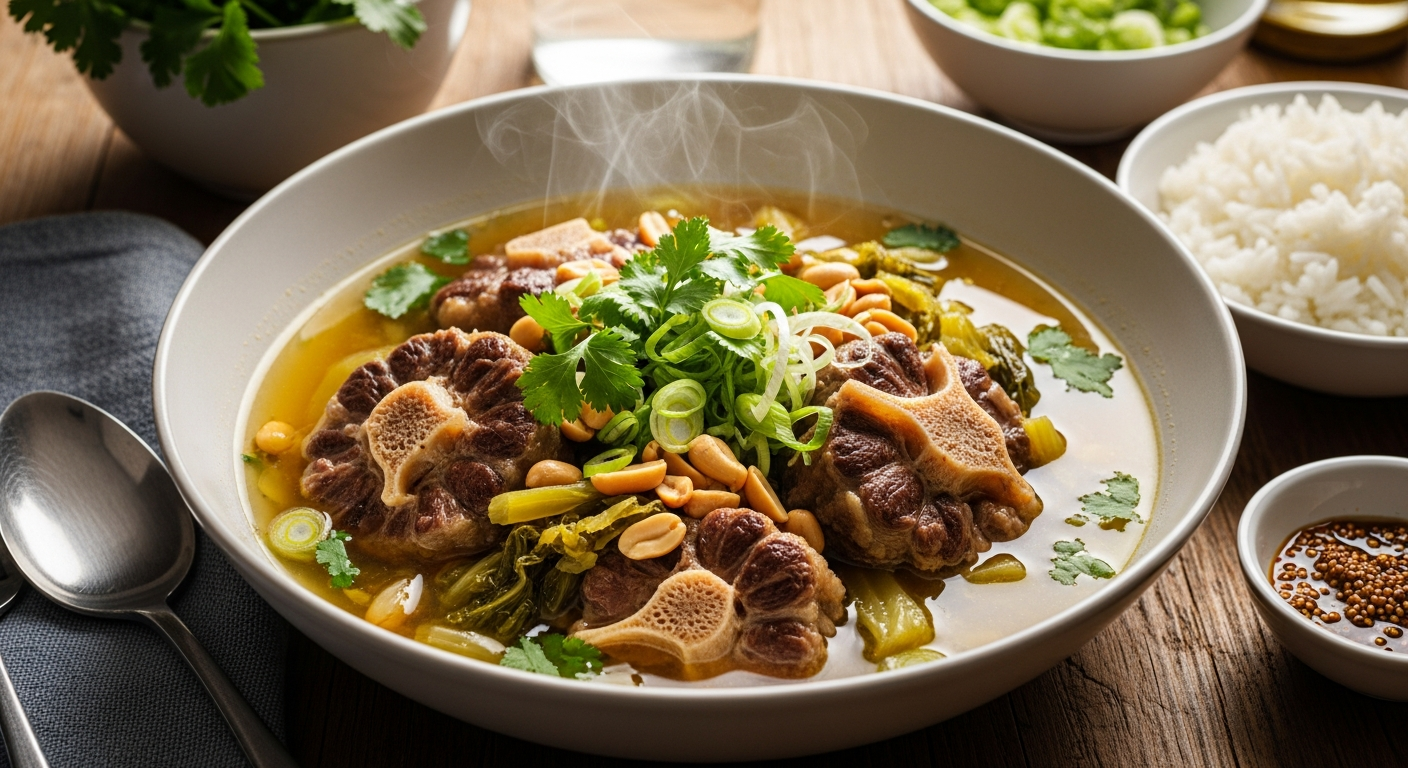
Ladle the oxtails, peanuts, mustard cabbage, and broth into deep bowls. Serve with a scoop of hot white rice on the side (or right in the bowl — your call). Garnish with chopped cilantro and green onions. The essential accompaniment is a small dish of soy sauce mixed with hot Chinese mustard for dipping the meat.
How to Eat It (Yes, There’s a Right Way)
Oxtail soup is an interactive meal. You pick up a piece of oxtail, dip it in the soy-mustard sauce, and gnaw every bit of meat off the bone. You slurp the broth — ideally over a spoonful of rice. You eat the soft peanuts and the slightly bitter mustard cabbage between bites of rich, gelatinous meat. The whole experience should take a while. This is not a rush-through-it meal.
Some locals pour the broth over their rice and eat it like a soup-rice. Others keep everything separate. There’s no wrong way — just make sure you have plenty of napkins, because the best oxtail pieces require both hands and zero dignity.
Pressure Cooker Shortcut
If you can’t commit to 3 hours of stovetop simmering, a pressure cooker (like an Instant Pot) can get you there in about 45 minutes at high pressure. Still do the blanching step — that’s non-negotiable for clear broth. After blanching, add all the broth ingredients to the pressure cooker with 10 cups of water (pressure cookers lose less liquid to evaporation). Cook on high pressure for 45 minutes, then let it natural release for 15 minutes. The broth won’t be quite as refined as the stovetop version, but it’s still excellent.
Tips for the Best Oxtail Soup
- Buy quality oxtails. Look for pieces with a good meat-to-bone ratio. Some pieces are almost all bone — ask your butcher to select meaty cuts.
- Don’t skip the blanch. This is the #1 mistake people make. It takes 10 minutes and makes or breaks your broth.
- Never boil hard after blanching. A gentle simmer only. Hard boiling emulsifies the fat and makes cloudy broth.
- Make it the day before. Like most braises, oxtail soup is even better the next day. The broth sets into a jelly in the fridge — that’s all the collagen. Reheat gently and it melts back into the richest broth you’ve ever tasted.
- The peanuts are worth it. They absorb the broth and become these soft, savory little flavor bombs. If you’ve never had them in oxtail soup, you’re missing out.
Where Locals Get Their Fix
Every local has their oxtail soup spot. Kapahulu Avenue on Oahu is legendary — Asahi Grill and Mitsu-Ken (RIP) set the standard for generations. Zippy’s serves a solid everyday version. But ask anyone and they’ll tell you: the best oxtail soup is the one your tutu or aunty makes on Sunday morning, the one that fills the whole house with that star anise perfume and means family is about to sit down together.
Now you can make that version at home. Give it the time it deserves, and you’ll understand why this simple soup has been the heart of Hawaii’s Sunday table for over a century.