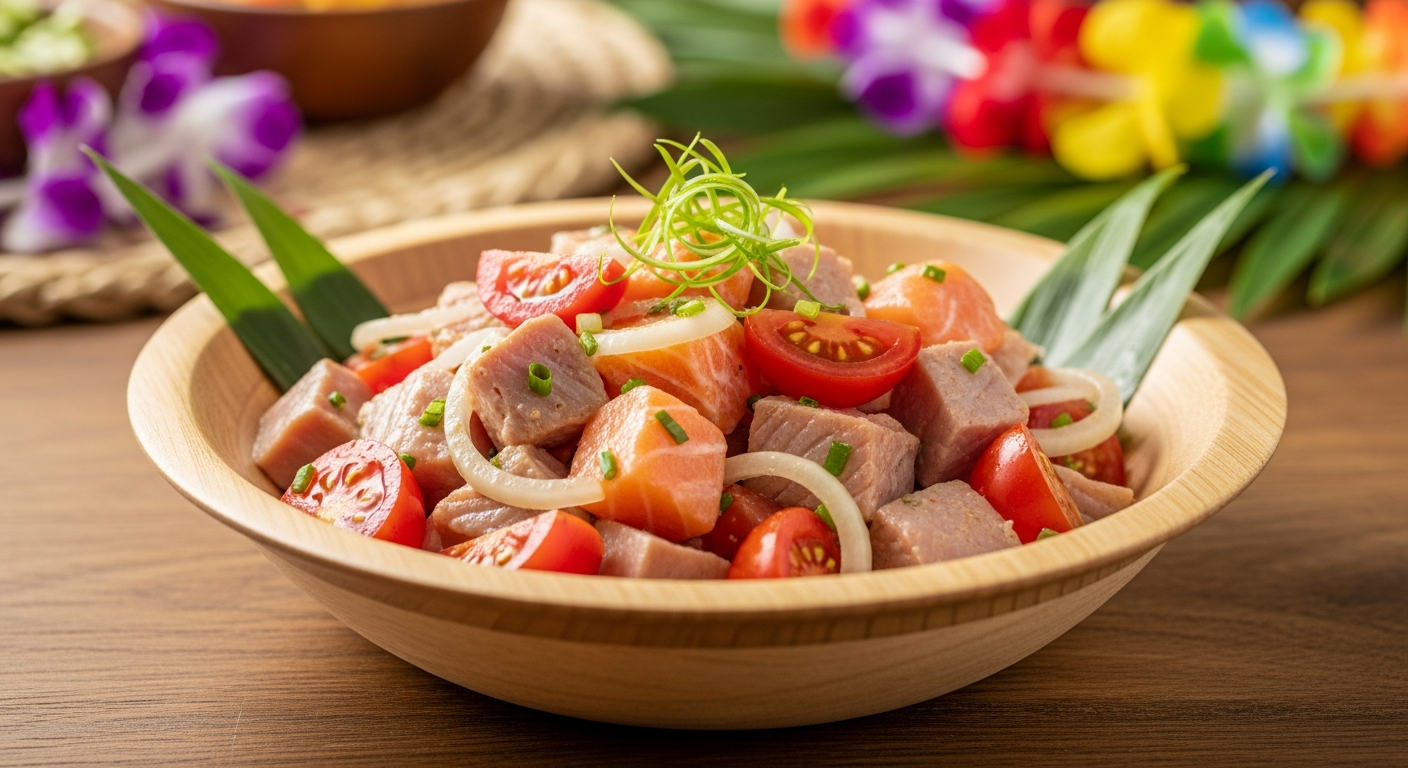
There is no luau without lomilomi salmon. It’s as non-negotiable as kalua pig and poi. Walk up to any luau spread in Hawaii — backyard, beach, community hall — and you’ll find a bowl of it sitting right there, cold and bright and ready to go. It’s the dish that cuts through all that rich, smoky pork with something fresh and salty and alive.
And once you’ve had the real thing, that store-bought stuff doesn’t come close.
What Is Lomilomi Salmon
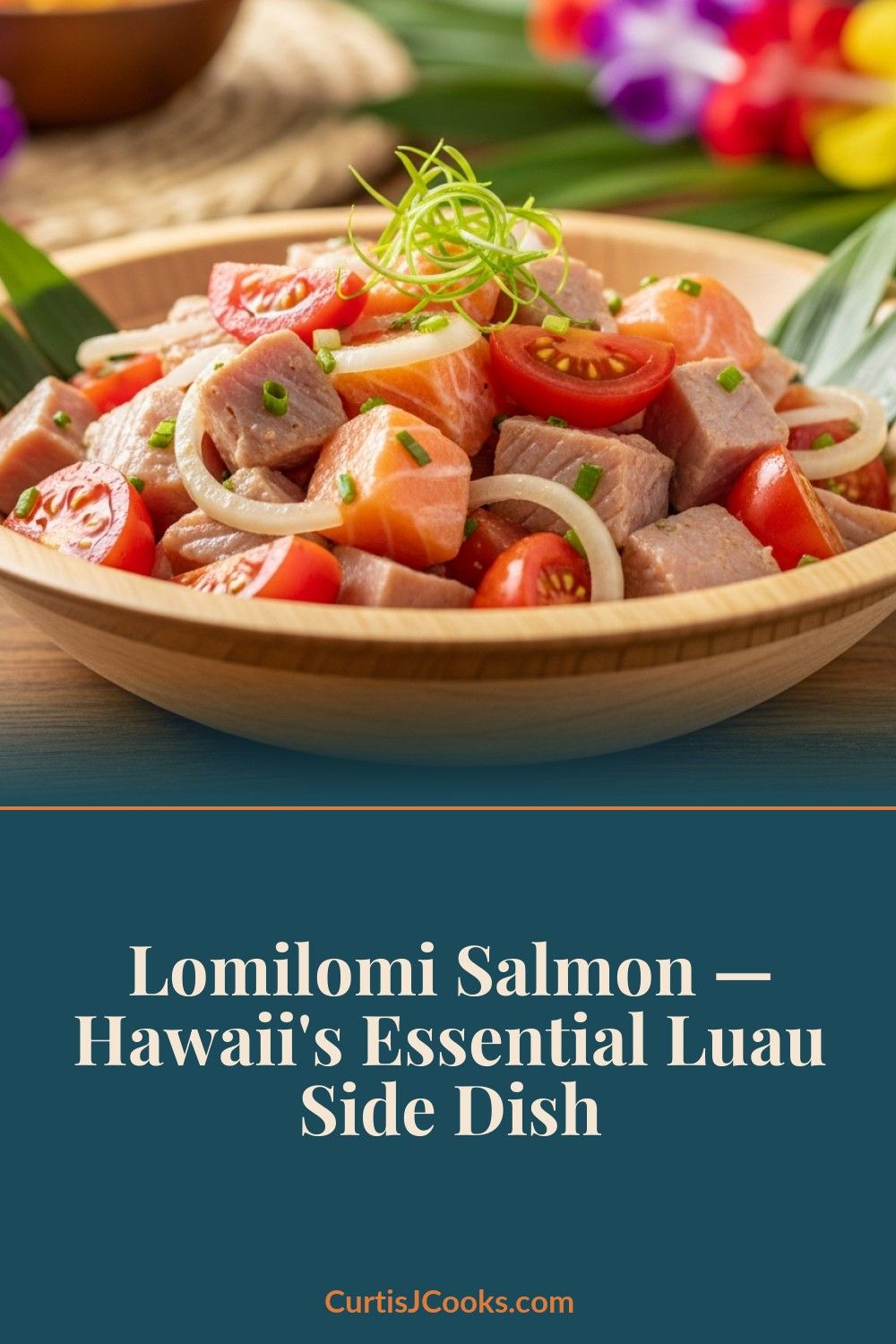
Lomilomi salmon (also spelled lomi-lomi or lomi salmon) is a traditional Hawaiian side dish made from salted salmon that’s been diced and “lomilomi’d” — massaged by hand — with fresh tomatoes, sweet onion, and green onions. The word lomilomi means “to massage” or “to knead” in Hawaiian, and that’s exactly what you do. You work the ingredients together with your hands until everything breaks down slightly and the flavors meld into something greater than the sum of its parts.
Free: Hawaiian Cooking Starter Kit
Get 5 essential island recipes + a printable pantry checklist — everything you need to start cooking Hawaiian at home.
No spam, ever. Unsubscribe anytime.
It’s served cold, almost like a salsa or a relish, and it’s the perfect contrast to the heavy, rich dishes that dominate a Hawaiian feast. Where kalua pig is smoky and fatty, and laulau is deep and earthy, lomilomi salmon is bright, salty, and refreshing. It wakes up your palate between bites.
The Luau Table Essential
If you’ve ever been to a Hawaiian luau or a big family gathering, you know the spread. The table is loaded: kalua pig, laulau, chicken long rice, squid luau, poi, mac salad, rice. And right in the middle of all of it — a big bowl of lomilomi salmon.
It’s the dish everyone reaches for first because it goes with everything. Scoop it over rice. Eat it with poi. Pile it on top of kalua pig. Put it on a taro chip as a pupu before dinner even starts. There’s no wrong way.
At potlucks and holiday gatherings, lomilomi salmon is one of those dishes that disappears fast. Whoever made it gets the nod of approval. And if you show up to a luau without it? People notice.
The Traditional Method: Salt-Curing
The authentic way to make lomilomi salmon starts with salt-curing the fish. You take a good piece of salmon — skin-on is traditional — bury it in Hawaiian salt (pa’akai) or coarse sea salt, and let it cure in the fridge for at least 24 hours. This draws out moisture, firms up the flesh, and gives the salmon that characteristic salty, almost lox-like quality that defines the dish.
After curing, you rinse off the salt, taste a small piece, and if it’s too salty, soak it in cold water for 30 minutes to an hour. Then you shred or dice the salmon — traditionally by hand, breaking it apart with your fingers — and massage it together with the tomatoes and onions.
This is the way your tūtū (grandmother) made it. It takes time and patience, but the texture and flavor are unmatched.
Choosing Your Salmon
For the traditional salt-cured version, you want a skin-on salmon fillet — about a pound to a pound and a half. The variety matters less than the freshness:
- King (Chinook) salmon — richest flavor, highest fat content, the premium choice
- Sockeye salmon — deep red color, firmer texture, great for lomilomi
- Atlantic salmon — widely available, milder flavor, works perfectly fine
For the quick version, use sashimi-grade salmon from a trusted fishmonger. Since it won’t be cured, freshness is everything.
The Tomato and Onion Ratio
Everyone’s lomilomi salmon is a little different, but the classic ratio is roughly equal parts salmon, tomato, and onion by volume. Some families go heavier on the tomato for more juice and freshness. Others let the salmon be the star.
What matters most:
- Tomatoes — use ripe, firm Roma tomatoes. Seeded and diced so you get flesh, not watery pulp.
- Onion — Maui onion is the gold standard. Sweet, mild, and doesn’t overpower the fish. If you can’t find Maui sweet onion, Vidalia or Walla Walla work as substitutes.
- Green onions — the finishing touch. Adds color, freshness, and a mild bite.
Tips for the Best Lomilomi Salmon
- Use your hands — this is called lomilomi for a reason. Gently massage and squeeze the ingredients together. You’re not just mixing — you’re breaking down the salmon slightly and working the tomato juices into the fish.
- Chill before serving — lomilomi salmon always tastes better after it sits in the fridge for at least an hour. The flavors meld and the dish firms up. Overnight is even better.
- Taste and adjust salt — if you’re using the cured method, the salmon brings all the salt you need. For the quick version, you’ll need to season with Hawaiian salt or sea salt.
- Don’t skip the Maui onion — regular yellow onion is too sharp. The sweetness of Maui onion is what balances the salt of the fish.
- Keep it chunky — you want distinct pieces, not a mush. Dice everything into roughly the same size for the best texture.
Quick Version: 30-Minute Lomilomi Salmon
Don’t have 24 hours? Here’s the shortcut that still delivers:
Skip the curing step entirely. Use fresh sashimi-grade salmon, dice it small, and toss it with the tomatoes, onion, and green onions. Season with Hawaiian salt (about 1 teaspoon, then adjust to taste) and a squeeze of fresh lime juice. Refrigerate for at least 30 minutes to let the flavors come together.
Is it the same as the traditional version? No — the texture of the salmon is different, softer and more delicate instead of firm and salty. But it’s still delicious, and when you need lomilomi salmon for tonight’s dinner, this gets the job done.
Serving Lomilomi Salmon
Lomilomi salmon is traditionally served cold, straight from the fridge. Here’s how to enjoy it:
- At a luau — in a big communal bowl, scooped alongside kalua pig and poi
- On a plate lunch — as a cold side next to rice and a hot main
- As a pupu — on taro chips or crackers as an appetizer
- Over rice — a scoop of lomilomi salmon on hot white rice with a drizzle of the juices
It keeps well in the fridge for 2-3 days, though it rarely lasts that long. If anything, it gets better on day two as the flavors continue to develop.
A Dish That Tells a Story
Lomilomi salmon is one of those dishes that carries the whole history of Hawaiian food in a single bowl. It speaks to the resourcefulness of preserving fish with salt, the tradition of preparing food by hand with care and intention, and the way every dish at a Hawaiian table has its purpose — its role in the bigger meal.
When you make lomilomi salmon, you’re not just making a side dish. You’re making the thing that ties the whole feast together. And at any gathering worth its salt — literally — that bowl will be the first thing to empty and the first thing people ask about.