Taro is the single most important plant in Hawaiian culture. Not just as food — though it is the foundation of the Hawaiian diet — but as family. Hawaiians consider taro (kalo in Hawaiian) to be their elder brother, a literal ancestor whose story is woven into the creation of the Hawaiian people themselves.
If you’ve eaten poi, you’ve eaten taro. If you’ve had purple taro waffles or poi pancakes at a Hawaiian brunch spot, that’s taro too. But the plant itself — what it is, where it grows, why it matters so deeply — is a story most people outside Hawaii have never heard.
What Taro Actually Is
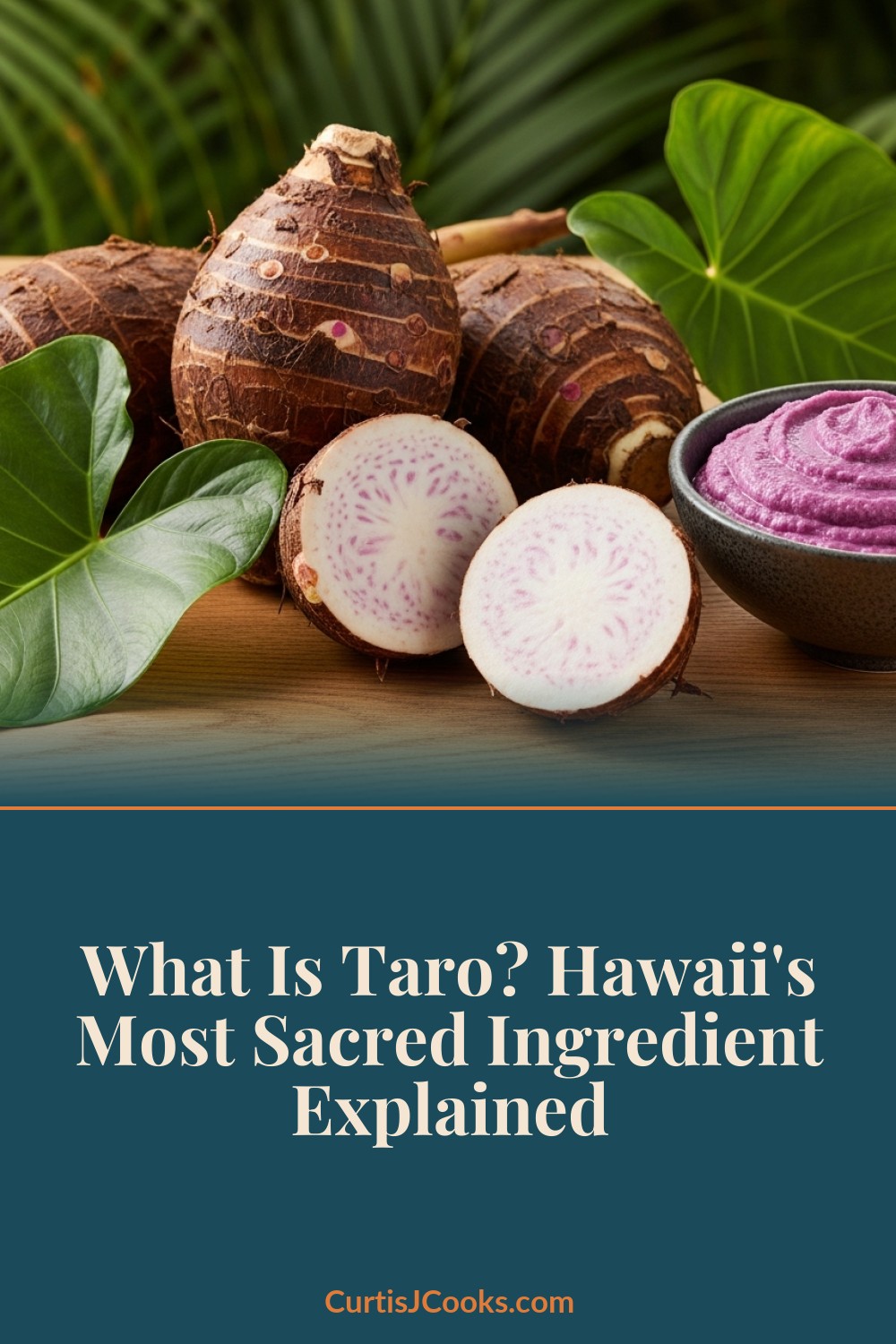
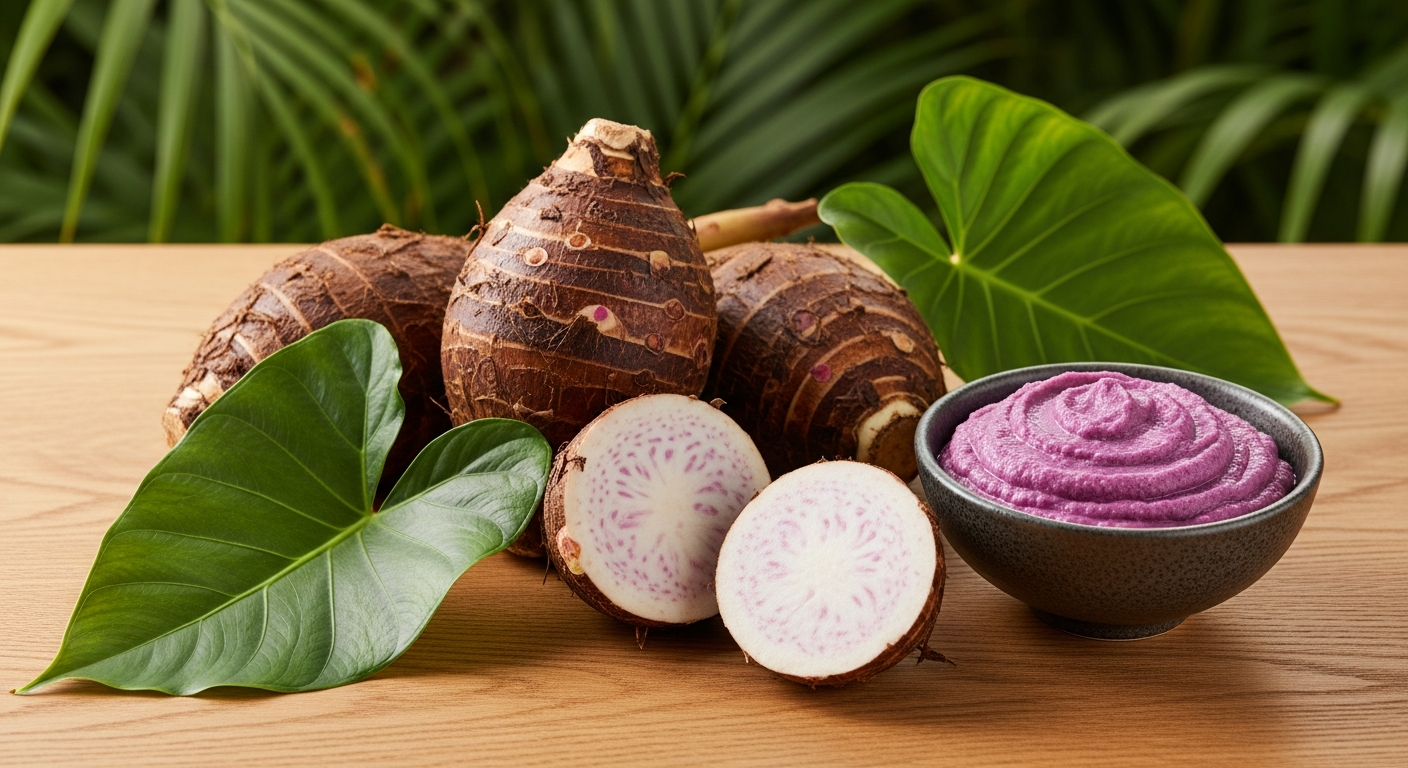
Taro (Colocasia esculenta) is a tropical root vegetable that’s been cultivated for over 7,000 years, making it one of the oldest crops on earth. The edible part is the corm — a starchy, bulbous underground stem that looks like a rough, hairy potato with purple-white flesh inside.
Free: Hawaiian Cooking Starter Kit
Get 5 essential island recipes + a printable pantry checklist — everything you need to start cooking Hawaiian at home.
No spam, ever. Unsubscribe anytime.
The plant itself is striking: large, heart-shaped leaves on long stems that can grow three to four feet tall. In Hawaii, taro is grown in flooded paddies called loʻi kalo, where the plants sit in shallow, flowing water fed by mountain streams. The loʻi system is one of the most sustainable forms of agriculture ever developed — the water flows in, nourishes the taro, and flows out clean enough to support fish and other crops downstream.
There are roughly 300 varieties of taro worldwide, and ancient Hawaiians cultivated about 300 of their own named varieties — more than any other Polynesian culture. Today, around 70 Hawaiian taro varieties are still grown, though most commercial taro in Hawaii comes from a handful of varieties suited to wetland cultivation.
The Hawaiian Creation Story: Taro as Family
This is what separates taro from every other crop in Hawaii. In the Hawaiian creation story (the Kumulipo), Wākea (Sky Father) and Hoʻohōkūkalani had a first-born son named Hāloa-naka, who was stillborn. They buried him, and from his body grew the first taro plant. Their second son, also named Hāloa, became the ancestor of all Hawaiian people.
This means taro is not just food. It is the older sibling of the Hawaiian people. Caring for taro is caring for family. Eating taro is receiving nourishment from an ancestor. This relationship shapes everything about how Hawaiians interact with the plant — from how it’s cultivated to how it’s served at the table.
Traditionally, when the poi bowl was uncovered at a meal, all arguing and conflict had to stop. The presence of taro — of the elder brother — demanded peace and respect. This protocol still holds meaning in many Hawaiian families today.
How Taro Tastes
If you’ve never had taro, here’s what to expect: it’s starchy, mildly sweet, and earthy — somewhere between a potato and a chestnut, with a slightly nutty undertone. The flavor is subtle, not bold. Taro doesn’t compete with other ingredients; it grounds them.
The texture depends on how it’s prepared:
- As poi — Smooth, creamy paste ranging from thick (one-finger poi) to thin (three-finger poi). Fresh poi is mildly sweet; after a day or two it ferments slightly and develops a pleasant tanginess
- Steamed or boiled — Dense and starchy like a firm potato, with a slightly sticky texture
- In baked goods — Adds moisture, a subtle sweetness, and that distinctive purple-lavender color
- As chips — Crispy and slightly sweeter than potato chips, with an earthy depth
The purple color is the most visually striking thing about taro. It comes from anthocyanins — the same antioxidant pigments found in blueberries and red cabbage. Not all taro varieties are purple (some are white or cream-colored), but the purple ones are the most popular in Hawaiian cooking.
How Taro Is Used in Hawaiian Cooking
Poi — The Foundation
Poi is pounded taro mixed with water — and it’s the most important preparation. For centuries, poi was the center of every Hawaiian meal. It’s still served at luaus, family gatherings, and in homes across the islands. Our complete poi guide covers its history, how it’s made, and why it matters.
Luau Leaves
The leaves of the taro plant (called luau leaves) are edible when cooked thoroughly. They’re used in laulau — pork and fish wrapped in taro leaves and steamed until the leaves break down into a silky, spinach-like layer. They’re also the key ingredient in squid luau, cooked down with coconut milk into a rich, earthy stew. The word “luau” itself comes from the taro leaf — that’s how central this plant is to Hawaiian gathering and celebration.
Kulolo
Kulolo is an ancient Hawaiian dessert made from grated taro and coconut milk, baked slowly until it becomes dense, fudgy, and deeply flavored. It’s one of the oldest Hawaiian recipes still made today and one of the most delicious — sweet, earthy, and coconut-rich.
Modern Taro Dishes
Contemporary Hawaiian cooking has found new ways to use taro while honoring its significance:
- Taro waffles — Purple, slightly sweet, and stunning on a brunch table
- Poi pancakes — Earthy purple pancakes that are a modern breakfast staple
- Taro chips — Thinly sliced and fried, a popular snack across the islands
- Taro smoothie bowls — Blended with coconut milk and topped with granola and fruit
- Taro ice cream and mochi — Purple-hued desserts with that distinctive earthy sweetness
Nutrition
Taro is one of the most nutritious root vegetables available:
- High in fiber — More than potatoes, which makes it easier to digest and more filling
- Rich in potassium — Supports heart health and muscle function
- Good source of vitamins C and E — Antioxidant support
- Contains resistant starch — Feeds beneficial gut bacteria, supporting digestive health
- Naturally gluten-free — Makes taro flour a popular alternative for gluten-free baking
- Low glycemic index — Releases energy slowly, avoiding blood sugar spikes
Ancient Hawaiians thrived on a taro-based diet for centuries. Modern nutritional science confirms what they already knew — it’s an exceptional food.
Important: Raw taro contains calcium oxalate crystals that cause intense itching and irritation. Taro must always be cooked thoroughly before eating. This isn’t a safety concern in any prepared taro product — just don’t eat it raw.
Growing Taro in Hawaii
Taro cultivation is experiencing a revival in Hawaii. For decades, taro farming declined as commercial agriculture shifted to other crops. But a new generation of Hawaiian farmers is restoring ancient loʻi and bringing taro cultivation back to communities across the islands.
The primary growing regions are:
- Hanalei Valley, Kauai — The largest taro-growing region in Hawaii, responsible for most of the state’s commercial taro. The valley’s loʻi system is fed by mountain streams and has been cultivated for centuries
- Waipiʻo Valley, Big Island — A sacred valley with a long tradition of taro farming, now being restored by local families
- Windward Oahu — Several small farms in Waiāhole, Kahaluʻu, and Waimānalo grow taro for local markets
Growing taro is a deeply cultural act in Hawaii. Many of the farmers restoring loʻi are motivated not just by agriculture but by a desire to reconnect with Hawaiian identity and the Hāloa story — caring for the elder brother.
Where to Find Taro
In Hawaii: Fresh taro corms and poi are available at farmers’ markets across the islands, at grocery stores like Foodland and Times Supermarket, and at poi factories like Taro Ko Chips Factory on Maui. Any luau will serve poi, and most local restaurants offer it as a side.
On the mainland: Fresh taro can be found at Asian grocery stores (Chinese, Vietnamese, and Filipino markets typically carry it). Frozen poi is available online from Hawaiian retailers. Taro powder (for baking) is available on Amazon and at specialty stores. For sourcing all Hawaiian ingredients, check our Essential Hawaiian Ingredients Guide.
Taro vs Similar Root Vegetables
People sometimes confuse taro with other tropical roots:
- Taro vs ube (purple yam) — Different plants entirely. Ube is Filipino purple yam with a sweeter, more vanilla-like flavor. Taro is earthier and more subtle. Both are purple, but the shade and taste differ significantly
- Taro vs potato — Taro is starchier, denser, and has an earthy nuttiness that potatoes lack. Taro also has more fiber and nutrients
- Taro vs cassava — Cassava is drier and more neutral in flavor. Taro has more character — that earthy, slightly sweet quality that makes it distinctive
Why Taro Matters
Taro is the thread that connects modern Hawaii to ancient Hawaii. When a family eats poi at a luau, they’re participating in a tradition that stretches back over a thousand years. When a farmer tends a loʻi, they’re caring for the same crop — and in Hawaiian understanding, the same family member — that sustained the islands long before Western contact.
Understanding taro is understanding Hawaii at its deepest level. The food, the culture, the identity — it all comes back to this one plant.
Ready to cook with taro? Start with homemade poi — the most fundamental Hawaiian recipe there is. From there, try kulolo for the ancient dessert, or taro waffles for a modern take. And explore our Essential Hawaiian Ingredients Guide for everything else that makes Hawaiian cooking unique.