Saimin is a noodle soup that exists only in Hawaii. It’s not ramen. It’s not wonton mein. It’s not pho or any other Asian noodle soup you can name. Saimin is its own dish — born on the sugar plantations where Japanese, Chinese, Filipino, Korean, and Portuguese workers shared meals and ingredients, and somehow created something that belonged to none of them and all of them at once.
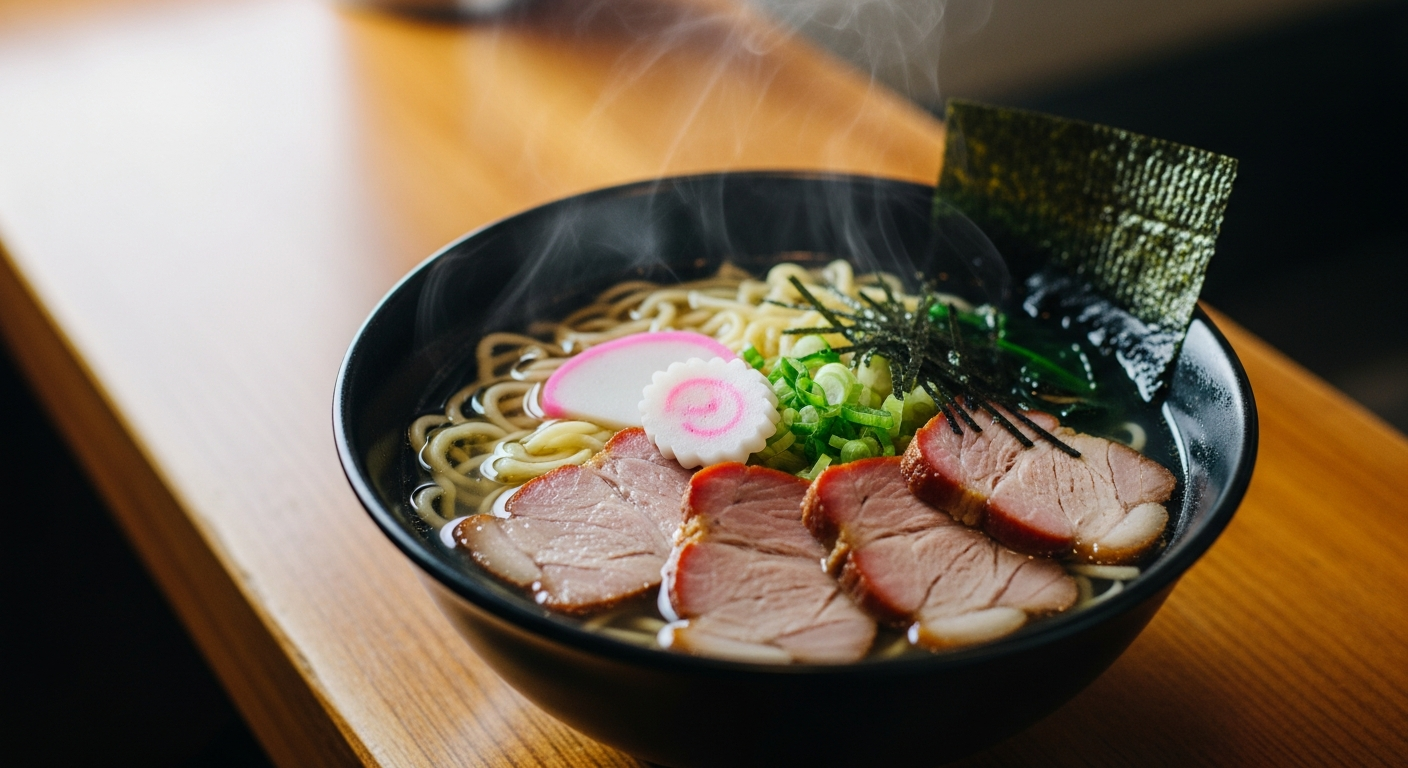
The soup is simple: soft wheat-and-egg noodles in a clear, shrimp-based dashi broth, topped with whatever’s available — usually char siu pork, green onions, kamaboko (fish cake), and a strip of nori. It’s comfort food at its most elemental, and it’s as Hawaiian as anything on the islands.
What Saimin Tastes Like
Saimin’s broth is lighter than ramen but more complex than it looks. The base is dashi — the Japanese stock made from kombu (kelp) and dried shrimp or bonito flakes — which gives it a clean, oceanic umami that’s savory without being heavy. Some versions add chicken or pork bones for body, but the defining flavor is always that shrimp-forward dashi.
Free: Hawaiian Cooking Starter Kit
Get 5 essential island recipes + a printable pantry checklist — everything you need to start cooking Hawaiian at home.
No spam, ever. Unsubscribe anytime.
The noodles are unique to saimin. They’re softer and chewier than ramen noodles, made with wheat flour and eggs, and they have a slight alkaline bounce from kansui (the same lye water used in ramen, but the result is a distinctly different texture). They’re meant to be slurped, and they hold the broth well.
The overall experience is warm, soothing, and uncomplicated. Saimin doesn’t hit you with intense spice or richness — it’s the soup equivalent of a deep breath. That’s why locals eat it when they’re sick, when they’re tired, when it’s raining, or when they just need something that feels like home.
The History of Saimin
Saimin was born in the plantation camps of Hawaii in the late 1800s and early 1900s. Workers from different countries lived in close quarters, and meal times became a cross-cultural exchange. The Japanese contributed the noodle-making technique and dashi. The Chinese contributed wonton wrappers and char siu. The Filipinos and Koreans added their own garnishes and seasoning ideas.
No single culture invented saimin — it emerged from the gaps between them. The word itself is debated: some say it comes from the Chinese “xi mian” (thin noodles), others point to Japanese origins. What’s certain is that by the early 20th century, saimin stands were popping up around plantation towns, serving bowls to workers for a few cents.
By the 1940s and 1950s, saimin had moved from the plantation camps into restaurants, drive-ins, and eventually into the most unlikely place of all: McDonald’s. Hawaii is the only place in the world where McDonald’s serves saimin — and locals order it without irony. That’s how embedded this soup is in island culture.
Today, saimin is served everywhere from hole-in-the-wall noodle shops to school cafeterias to Zippy’s (Hawaii’s beloved local chain). It’s the soup that every kid in Hawaii grew up eating, and the one that adults still crave on a cold, rainy night.
Saimin vs Ramen
This is the comparison everyone makes, and saimin loses every time — not because it’s worse, but because people judge it by ramen standards. They’re fundamentally different soups:
| Saimin | Ramen |
|---|---|
| Clear, light dashi-shrimp broth | Rich, heavy pork/chicken/miso broth |
| Soft, chewy egg noodles | Firmer, springier alkaline noodles |
| Simple toppings (char siu, kamaboko, green onion) | Elaborate toppings (chashu, egg, bamboo, nori, corn) |
| Plantation fusion (multi-ethnic origin) | Japanese regional specialties |
| Comfort food, casual, everyday | Often elevated, artisan, trend-driven |
| Only exists in Hawaii | Global phenomenon |
Ramen is a deep dive into one broth style. Saimin is a warm hug. They serve different purposes, and comparing them misses the point of both.
Classic Saimin Toppings
A traditional bowl of saimin comes with a handful of simple toppings:
- Char siu — Thin slices of Chinese BBQ pork, sweet and slightly smoky. The most essential saimin topping.
- Kamaboko — Pink-and-white Japanese fish cake, sliced into thin half-moons. Adds a mild, slightly sweet seafood flavor and that distinctive two-tone look.
- Green onions — Sliced thin and scattered on top. Adds brightness and a mild bite.
- Nori — A strip of dried seaweed that softens in the broth. Adds umami and visual contrast.
- Scrambled egg — Some versions include strips of thin scrambled egg (like a Japanese tamago omelet), adding richness.
- Spam — Sliced and pan-fried, because this is Hawaii. Not traditional, but extremely common.
Where to Eat Saimin in Hawaii
Saimin is everywhere in the islands. Here are the spots that locals argue over:
Oahu
- Shiro’s Saimin Haven (Aiea) — The gold standard. Family-run since the 1950s, with handmade noodles and a broth that tastes like decades of refinement.
- Palace Saimin (Kalihi) — Another old-school classic. Cash only, no-frills, perfect saimin.
- Zippy’s (islandwide) — Hawaii’s favorite chain restaurant serves a solid bowl that hits every comfort note. Many locals grew up on Zippy’s saimin.
- McDonald’s (Hawaii locations only) — Yes, really. The McDonald’s saimin is surprisingly decent and comes in a proper bowl with char siu, kamaboko, and green onions.
Maui
- Sam Sato’s (Wailuku) — Famous for their dry noodles (saimin noodles without broth, served with char siu and dipping broth on the side). A Maui institution since 1933.
Big Island
- Nori’s Saimin & Snacks (Hilo) — A Hilo landmark with generous portions and homemade broth.
Types of Saimin
While the classic bowl is the standard, saimin has evolved into several variations:
- Regular saimin — The standard: noodles in broth with char siu, kamaboko, green onion, and nori.
- Special saimin — Everything in the regular plus extra toppings: more meat, wontons, vegetables, sometimes a fried egg on top.
- Wonton saimin — Saimin with pork-filled wontons added. The wontons absorb the broth and add a dumpling element.
- Fried saimin — Saimin noodles stir-fried with vegetables, char siu, and soy sauce — no broth. Think of it as Hawaii’s lo mein. It’s a popular side dish at plate lunch shops.
- Dry noodles — Sam Sato’s specialty: the noodles are served without broth, tossed in a light sauce, with dipping broth on the side. A Maui innovation.
How to Pronounce Saimin
It’s SAI-min. Two syllables. “Sai” rhymes with “eye” (with an S in front), and “min” sounds like “min” in “minute.” Say it with confidence and no extra syllables.
Making Saimin at Home
Saimin is one of the easiest Hawaiian dishes to make at home. The broth comes together in 30 minutes, and the toppings are simple pantry items. The key is the dashi base — if you get that right, you’re 90% there.
The basic approach: make a shrimp dashi (dried shrimp simmered with kombu and a splash of soy sauce), cook your noodles, and top with whatever you have — char siu, Spam, kamaboko, green onions. For the full step-by-step, my saimin recipe walks through every detail.
If you can’t find saimin noodles on the mainland, fresh Chinese egg noodles or even fresh ramen noodles from an Asian grocery store will work. They won’t be exactly right, but they’ll get you close enough to scratch the itch.
Saimin and Local Identity
Saimin matters to Hawaii in a way that goes beyond food. It’s the dish that proves Hawaiian cuisine isn’t any single ethnic tradition — it’s the mix. No one culture can claim saimin, and that’s exactly why it’s so Hawaiian. The plantations were brutal places, but the people who survived them created something lasting at the dinner table: a food culture where Japanese dashi, Chinese noodles, Filipino garnishes, and Korean flavors all sit in the same bowl.
When locals talk about saimin with affection — and they do, constantly — they’re not just remembering a soup. They’re remembering childhood, family, rain on a tin roof, and the feeling of being home. It’s a bowl of noodles that carries the weight of an entire island identity, and it does it with nothing more than broth, noodles, and a few slices of char siu.