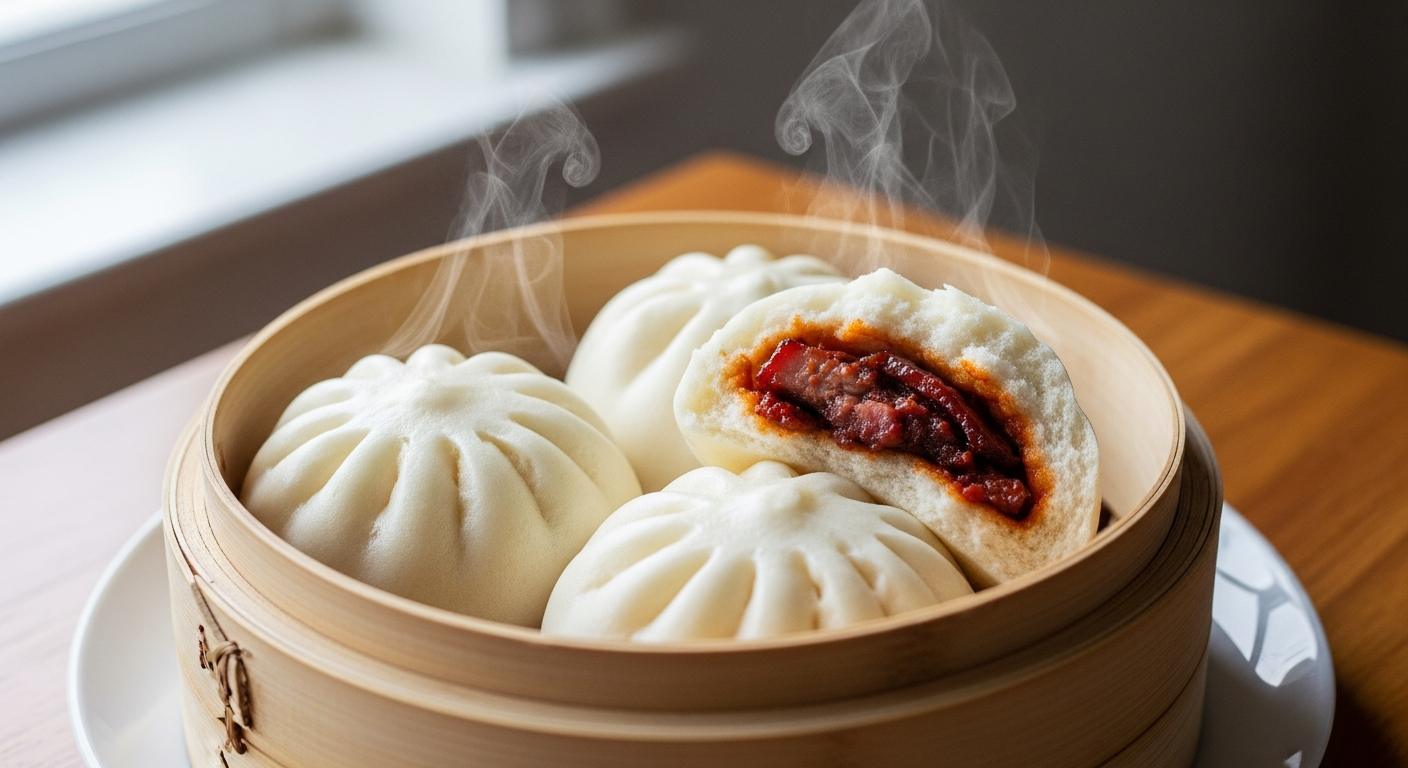
Manapua is Hawaii’s version of char siu bao — a soft, fluffy steamed bun stuffed with sweet Chinese-style barbecue pork. The name comes from the Hawaiian words “mea ʻono puaʻa,” which translates roughly to “delicious pork thing.” That’s the most honest food name in existence, and it tells you everything you need to know about what’s inside.
If you grew up in Hawaii, manapua means one thing: the manapua man. A truck rolling through the neighborhood, horn honking, kids running out with whatever change they could find. The buns were warm, the pork was sweet, and nothing that came out of a truck has ever tasted that good since.
What Manapua Tastes Like
The outside is a pillowy, slightly sweet steamed dough that’s cloud-soft and tears apart easily. The inside is char siu pork — diced or shredded Chinese BBQ pork in a sweet, savory, slightly sticky sauce. The combination of the bland, soft bread and the intensely flavored filling is what makes manapua work. Each bite gives you both textures and both flavor profiles at once.
Free: Hawaiian Cooking Starter Kit
Get 5 essential island recipes + a printable pantry checklist — everything you need to start cooking Hawaiian at home.
No spam, ever. Unsubscribe anytime.
The best manapua has a filling-to-dough ratio that leans generous. Nobody wants a mouthful of bread with a tiny smear of pork in the center. The filling should be abundant, saucy, and sweet enough that it almost caramelizes against the dough.
Eaten warm, manapua is one of the most satisfying handheld foods you’ll ever have. It’s a complete meal in your palm — protein, carb, and flavor, all in one soft package.
The History of Manapua in Hawaii
Manapua arrived in Hawaii with Chinese immigrants during the plantation era in the mid-to-late 1800s. Cantonese workers brought their tradition of char siu bao — steamed buns filled with barbecue pork that had been a staple of dim sum and street food in southern China for centuries.
In Hawaii, the dish was adopted quickly. The Hawaiian language gave it a new name — manapua — and it became part of the island food vocabulary alongside other Chinese-Hawaiian contributions like saimin, crack seed, and fried wontons.
The manapua man became a cultural institution. Starting in the early 1900s, Chinese vendors would load up carts (and later trucks) with fresh steamed buns and drive through residential neighborhoods, selling them door to door. The horn honk became a Pavlovian signal for an entire generation of island kids. By the mid-20th century, manapua trucks were as much a part of Hawaiian neighborhood life as the ice cream truck was on the mainland — except the food was better.
Today, manapua men are rarer than they used to be (economics and regulations have thinned the fleet), but the tradition survives in bakeries, dim sum restaurants, and convenience stores across the islands. 7-Eleven in Hawaii sells manapua in their hot food cases. So does Zippy’s. It’s fast food in the truest sense — food you eat fast because you can’t wait.
Manapua vs Char Siu Bao
Manapua and char siu bao are essentially the same dish, but Hawaii’s version has evolved:
- Size. Hawaiian manapua are generally larger than traditional Cantonese char siu bao. A single manapua is a meal; a single bao is one piece of a dim sum spread.
- Dough sweetness. Hawaiian manapua dough tends to be slightly sweeter than traditional bao dough, reflecting the island preference for sweet-savory combinations.
- Filling variety. While traditional bao sticks mostly to char siu pork, Hawaiian manapua shops now offer dozens of fillings — curry chicken, kalua pig, sweet potato, ube, hot dog, and more.
- The name. In Hawaii, nobody calls it char siu bao. It’s manapua, full stop. Using the Chinese name marks you as either a mainland transplant or someone who just learned about dim sum.
Types of Manapua
The classic char siu pork filling is the original, but Hawaiian manapua has expanded into a whole category:
By Cooking Method
- Steamed (traditional) — Soft, white, pillowy. The dough is smooth and slightly sticky on the outside. This is the original and still the most popular.
- Baked (manapua style) — The dough is baked instead of steamed, giving it a golden-brown exterior with a slightly firmer texture. The top is often brushed with an egg wash for shine. Some people call these “baked bao” to distinguish them.
By Filling
- Char siu (BBQ pork) — The classic. Sweet, savory, saucy barbecue pork. The benchmark against which all other fillings are measured.
- Kalua pig — A Hawaiian twist: smoky shredded pork in place of char siu. The smokiness against the sweet dough is outstanding.
- Curry chicken — A popular alternative filling with a mild curry sauce. Common at manapua shops.
- Sweet potato — Purple Okinawan sweet potato or regular sweet potato, mashed and sweetened. A dessert manapua.
- Ube (purple yam) — Similar to sweet potato but with the distinctive ube flavor. Visually striking when you bite in.
- Hot dog — A whole hot dog wrapped in manapua dough and steamed. This sounds wrong and tastes incredibly right. A local kid’s favorite.
- Pepeiao (black sugar) — No filling — just sweet dough with brown sugar. The simplest version and a nostalgic favorite.
Where to Get Manapua in Hawaii
Oahu
- Royal Kitchen (Chinatown, Honolulu) — Many locals consider this the best manapua in Hawaii. Their baked manapua has a devoted following. Cash only, tiny shop, massive flavor.
- Char Hung Sut (Chinatown) — Another Chinatown institution. Famous for their manapua and pork hash (open-topped dumplings). Old-school and excellent.
- Libby Manapua Shop (Kalihi) — A neighborhood favorite with generous fillings and consistently great dough.
- 7-Eleven (islandwide) — Surprisingly good manapua in the hot food case. Not the best on the island, but available at 2 AM, which counts for something.
Other Islands
- Sack N Save / KTA (Big Island) — Local grocery stores with solid manapua in their deli sections.
- Home Ma-in (Maui) — A Maui favorite for Filipino and Hawaiian baked goods including manapua.
How to Pronounce Manapua
It’s MAH-nah-POO-ah. Four syllables. “Ma” like “mama,” “na” like “nah,” “pu” like “poo,” “a” like “ah.” The emphasis falls lightly on the third syllable. Say it smoothly and it rolls right off the tongue.
Making Manapua at Home
Manapua is a project, but it’s a rewarding one. The dough requires yeast and a rise time, and the char siu filling is best made from scratch (though store-bought char siu works in a pinch). The steaming process is straightforward once you have a steamer basket or bamboo steamer.
The key is the dough — it needs to be soft, slightly sweet, and pillowy after steaming. Too much flour and it’s dense; too little and it collapses. My manapua recipe walks through the exact ratios and technique to get that perfect cloud-like texture.
The Manapua Man
No discussion of manapua is complete without the manapua man. For decades, independent vendors drove trucks through Hawaii’s neighborhoods selling fresh steamed buns, along with other snacks like pork hash, half-moon pastries, and pepeiao. The horn honk was the signal, and the whole neighborhood responded.
The manapua man was more than a food vendor — he was a neighborhood fixture, a weekly ritual, and for many kids, their first experience of spending their own money on food. The tradition has faded as health regulations tightened and economics changed, but a few still operate. If you hear a horn and see a white truck, you run. Some things in Hawaii never change.
Why Manapua Matters
Manapua represents the same story that runs through all of Hawaiian food: an immigrant tradition that arrived with one culture, got adopted by everyone, and became something uniquely local. Chinese bao became Hawaiian manapua. The name changed. The size changed. The fillings expanded. But the core — soft dough, savory pork, eaten warm from your hand — stayed the same.
It’s the kind of food that carries memory. Ask anyone who grew up in Hawaii about manapua, and they don’t just describe a steamed bun — they describe a truck, a horn, a scramble for quarters, and the warmth of biting into something that tasted like their neighborhood. That’s what food culture really is: not recipes, but the stories wrapped around them.