
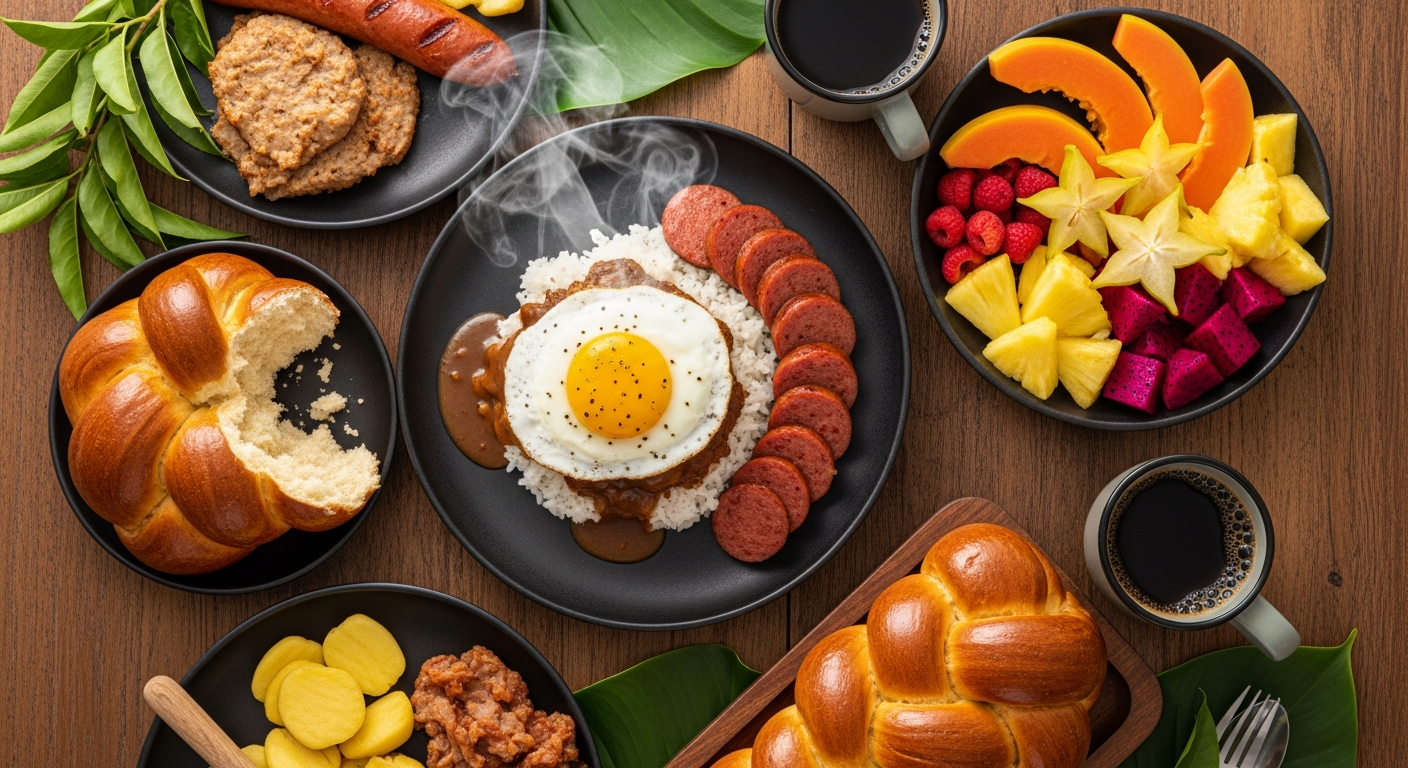
In Hawaii, breakfast isn’t something you rush through on the way out the door with a granola bar. It’s a full production—rice in the cooker, Spam sizzling in the pan, eggs cracking into cast iron, and the smell of Portuguese sausage filling the entire house before anyone’s even fully awake. That’s how mornings work in the islands.
Growing up, our breakfast table looked nothing like the cereal-and-toast spreads I’d see in mainland TV shows. We had rice. Always rice. Two scoops minimum. Eggs over easy so the yolk ran into the rice. And a protein—Spam, Portuguese sausage, kalua pig hash, whatever was in the fridge. It was the kind of breakfast that stuck with you through a long day, and honestly, I never understood why the rest of the country settled for less.
Hawaiian breakfast is a living record of the islands’ multicultural history. Japanese rice traditions, Portuguese sweet bread and sausage, Filipino garlic rice, Chinese-style fried rice, and Native Hawaiian staples like poi and taro—all of it comes together on one plate. This guide covers every corner of that tradition, with links to all our breakfast recipes so you can bring the islands to your morning table. Wondering what Hawaiians actually eat for breakfast on a regular morning? The answer might surprise you.
What Makes Hawaiian Breakfast Different
If you’re coming from a mainland breakfast mindset, here’s the fundamental shift: rice replaces toast. That’s the foundation everything else is built on. Once you accept that, everything else falls into place. Our Hawaiian breakfast vs mainland breakfast comparison breaks down every difference—from Spam vs bacon to POG vs orange juice.
During the plantation era, workers from Japan, China, Portugal, the Philippines, and Korea arrived in Hawaii and brought their morning routines with them. Japanese workers brought rice and furikake. Portuguese immigrants brought linguica-style sausage and sweet bread. Filipino families brought garlic fried rice. Over generations, these traditions didn’t just coexist—they merged into something entirely new. Our History of Hawaiian Breakfast traces that full evolution from ancient poi to modern Spam and rice.
A few things you’ll notice about Hawaiian breakfast:
- Rice, not toast – Two scoops of sticky white rice is standard. Learn the technique in our Perfect Rice guide, and invest in a decent rice cooker—it’s the single most important appliance in a Hawaiian kitchen
- Eggs everywhere – Fried, scrambled, over-easy, in omelets. Eggs tie everything together. The runny yolk mixing into hot rice is non-negotiable
- Spam is not a joke – Hawaii consumes more Spam per capita than anywhere else in the world, and for good reason. Read how Spam became Hawaii’s favorite meat and you’ll understand
- Portuguese influence runs deep – Sweet bread, spicy sausage, malasadas. The Portuguese contribution to Hawaiian breakfast is enormous
- Japanese touches – Furikake on rice, nori wraps, tamagoyaki (rolled omelette). Subtle but essential. Our condiments guide covers the best brands
- Everything comes with a drink – POG juice (passion orange guava) or Kona coffee are the classic choices. Check our Kona coffee guide for the real deal
The Classics: Meat, Eggs, and Rice
This is the heart of Hawaiian breakfast—a protein, eggs, and rice. Simple formula, infinite satisfaction. Every local diner and drive-in runs on these combinations, and they’re the easiest place to start if you’re cooking Hawaiian breakfast for the first time.
Spam and Eggs
The one that raises eyebrows on the mainland and brings smiles in Hawaii. The key is pan-frying the Spam until the edges get crispy and slightly caramelized—that’s where the magic happens. We’ve got two versions depending on your mood:
- Spam and Eggs with Rice – The complete breakfast with all the fixings and the story of why mainlanders just don’t get it
- Spam and Rice – The stripped-down classic done right, the breakfast that fueled generations of plantation workers
And once you fall in love with Spam (you will), take it further with Spam Musubi—Hawaii’s iconic on-the-go snack that works just as well at breakfast as it does in a lunch bag. Our 5 musubi variations will keep things interesting, and the Bacon Avocado Spam Musubi is a modern twist that’s become a reader favorite. There’s even a plant-based version that actually delivers.
Portuguese Sausage and Eggs
If you’ve never had Portuguese sausage and eggs, you’re missing out on one of Hawaii’s greatest breakfast contributions. The sausage is slightly sweet, mildly spicy, and has a flavor profile completely different from mainland breakfast sausage. Brands like Redondo’s and Gouvea’s are the ones to look for—our Hawaiian Pantry guide covers where to source them.
Paired with rice, over-easy eggs, and maybe some sliced tomato on the side, this is what you’ll find at every local diner from Lihue to Hilo. It’s comfort food at its most fundamental.
Loco Moco
Created at the Lincoln Grill in Hilo back in 1949, loco moco has become Hawaii’s most famous breakfast dish—and for good reason. A bed of rice, a hamburger patty, rich brown gravy, and a sunny-side-up egg on top. It sounds simple because it is. It’s also devastatingly good.
The gravy is what separates a great loco moco from a mediocre one. Homemade always beats packet gravy. Our Aloha Friday deep dive covers every detail, including the gravy technique that makes all the difference. A good cast iron skillet is your best friend here—it gives the patty that perfect sear.
Corned Beef Hash and Rice
This one flies under the radar but it’s a staple in local homes. Corned beef hash with rice is pure pantry cooking—canned corned beef crisped up in a hot pan with onions, served over rice with eggs. It’s the kind of breakfast that costs almost nothing and tastes like a million bucks. Military families stationed in Hawaii helped spread this one, and it stuck around for good reason.
Vienna Sausage and Eggs
Another one that might confuse mainland visitors but is deeply beloved in the islands. Vienna sausage and eggs is classic local comfort—those little canned sausages pan-fried until they get some color, served with rice and eggs. It’s simple, it’s cheap, and it’s been fueling island mornings for generations.
Hawaiian-Style Eggs & Omelets
Hawaiian Eggs Benedict
Our island twist on the brunch classic: Eggs Benedict with Kalua Pork. Smoky, tender kalua pig replaces Canadian bacon, piled on a toasted English muffin with perfectly poached eggs and hollandaise. If you’re doing brunch for a special occasion—or just a really good Saturday—this is the one.
Fried Rice Omelette
The Local Style Fried Rice Omelette is pure island breakfast fusion. Day-old rice gets stir-fried with Spam, char siu, or whatever protein you have, then wrapped inside a fluffy omelette. It’s what happens when Japanese and American breakfast traditions meet in a hot pan, and it’s become a diner staple across the islands.
Sweet Hawaiian Breakfasts
Not every Hawaiian breakfast involves rice and a protein. The islands have an incredible tradition of sweet morning food, much of it rooted in Portuguese and Native Hawaiian ingredients.
Hawaiian Sweet Bread French Toast
Hawaiian Sweet Bread French Toast takes thick slices of King’s Hawaiian (or better yet, homemade sweet bread) and transforms them into something pillowy soft inside with slightly crispy, caramelized edges. Top with tropical fruit, macadamia nuts, and coconut syrup. This is weekend brunch material that’ll have people asking for seconds before they’ve finished their firsts.
Taro Waffles
Taro Waffles are gorgeous purple waffles made with taro that bring a subtle, earthy sweetness to your morning. They’re Instagram-worthy, sure, but more importantly they’re delicious—slightly nutty, naturally sweet, and unlike any waffle you’ve had on the mainland. Taro is one of Hawaii’s most sacred and ancient ingredients, and this is a beautiful way to incorporate it into breakfast.
Poi Pancakes
Poi Pancakes are another way taro shows up at the breakfast table. That distinctive purple color and earthy-sweet flavor make these unlike any pancake you’ve had before. They’re a nod to the Native Hawaiian tradition of poi while working perfectly in a modern breakfast context.
Malasadas
Technically a snack or dessert, but let’s be honest—malasadas are a breakfast food in Hawaii. These Portuguese-style donuts are light, airy, rolled in sugar, and absolutely irresistible warm. Leonard’s Bakery on Oahu has been making them since 1952, and the line out the door every morning tells you everything you need to know. Making them at home is a project, but a deeply rewarding one.
Lighter Options
Not every morning calls for Spam and eggs. Hawaii’s tropical climate and abundance of fresh fruit mean there are plenty of lighter breakfast options that still feel distinctly island.
Hawaiian Acai Bowl
The Hawaiian Acai Bowl has become a morning staple across the islands—thick, creamy frozen acai topped with granola, fresh tropical fruits, honey, and whatever else catches your eye. It’s refreshing, filling, and works perfectly after an early morning surf or hike. The key is getting the acai thick enough that your spoon stands up in it.
Haupia Smoothie
Our Haupia Smoothie is a creamy coconut breakfast blend inspired by the beloved Hawaiian coconut dessert. It’s like drinking haupia for breakfast, and honestly, there are worse ways to start your day. Learn how to make fresh coconut milk the Hawaiian way for the best results.
POG Juice
POG—Passion Orange Guava—is the quintessential Hawaiian breakfast drink. Sweet, tropical, and bright, it’s been a staple since the 1970s. Making it fresh at home with real fruit is a world apart from the bottled stuff. Our tropical fruits guide covers sourcing the best ingredients.
Hawaiian Breakfast Drinks
What you drink with breakfast matters in Hawaii just as much as what you eat.
- POG Juice – Passion Orange Guava, the iconic island breakfast drink. Make it fresh and you’ll never go back to bottled
- Iced Kona Coffee – Hawaii’s local-style afternoon pick-me-up works just as well in the morning. Our Kona coffee guide helps you find the real thing (not the 10% blends)
- Haupia Smoothie – Creamy coconut breakfast blend that doubles as a meal
For more Hawaiian drinks beyond breakfast, explore our Island Drinks Guide.
Tips for Perfect Hawaiian Breakfast at Home
After years of cooking Hawaiian breakfast for family and friends on the mainland, here’s what I’ve learned makes the biggest difference. For the full mainland guide with sourcing tips, ingredient substitutions, and a step-by-step morning routine, see our complete guide to making Hawaiian breakfast at home.
- Get a rice cooker – This is not optional. A good rice cooker is the foundation of every Hawaiian kitchen. Use Calrose medium-grain rice for that sticky, slightly sweet texture. Our rice guide covers the technique
- Cook rice the night before – For fried rice dishes and omelets, day-old rice has better texture. Set the rice cooker timer, wake up to fresh rice, or use last night’s leftovers
- Get your pan hot – Spam and Portuguese sausage need a properly heated pan for that crispy caramelization. A cast iron skillet is ideal
- Don’t skimp on eggs – Two eggs minimum, three is better. Over-easy is the traditional style so the yolk runs into the rice. That’s not messy—that’s the whole point
- Stock your pantry – Keep Spam, Portuguese sausage, rice, furikake, and shoyu on hand and you can make a Hawaiian breakfast any morning. Our Hawaiian Pantry guide has the complete shopping list, and the Ingredients Guide helps with sourcing
- Embrace the mix plate – The beauty of Hawaiian breakfast is that everything goes on one plate. Rice, eggs, protein, maybe a little hot sauce. It’s not fancy. It’s perfect
Essential Breakfast Gear
Hawaiian breakfast doesn’t require a lot of specialized equipment, but what you do have should be quality.
- Rice Cooker – The single most important appliance. Period
- Cast Iron Skillet – For perfectly seared Spam, crispy Portuguese sausage, and fried eggs with lacy edges
- Kitchen Appliances Guide – Everything else you might need for Hawaiian meal prep
- Essential Utensils – The small tools that make a big difference
- Spam Musubi Makers – If musubi becomes part of your morning routine (it will), a mold makes it effortless
Where to Eat Breakfast in Hawaii
Every island has diners and drive-ins that have been serving breakfast the same way for decades. Seeking them out is one of the best things you can do on a trip to Hawaii.
- Liliha Bakery (Oahu) – Legendary for their coco puffs and classic diner breakfast. The Nimitz location is a Honolulu institution
- Rainbow Drive-In (Oahu) – Since 1961. Their loco moco and mixed plate breakfasts are the standard
- Zippy’s (Oahu, multiple locations) – Hawaii’s beloved chain. The chili and rice breakfast is a local addiction
- Cafe 100 (Hilo, Big Island) – Birthplace of the loco moco. Yes, you should make the pilgrimage
- Sam Sato’s (Maui) – The dry mein is legendary but the breakfast is quietly excellent
- Hamura Saimin Stand (Kauai) – Technically a saimin shop, but locals come for breakfast too
- Leonard’s Bakery (Oahu) – For malasadas. Get there early and get them hot
And don’t overlook the grocery stores—Foodland and Times Supermarket both have hot food counters that serve solid local breakfast at great prices. Sometimes the best breakfast is a $5 plate from the hot bar eaten on the beach.
Hawaiian Brunch: Taking It Up a Notch
When you want to go beyond the everyday and make breakfast an event, these recipes bring the special occasion energy:
- Hawaiian Eggs Benedict – Kalua pork, poached eggs, hollandaise. The ultimate island brunch centerpiece
- Sweet Bread French Toast – Stack it high with tropical fruit and coconut syrup
- Taro Waffles – Beautiful purple waffles that taste as good as they look
- Acai Bowls – Thick, loaded, and refreshing
- Loco Moco – Because sometimes the best brunch is just a really well-made loco moco
Planning a bigger gathering? Our Hawaiian Backyard Party Guide includes breakfast and brunch menu ideas that scale for a crowd.
Understanding Hawaiian Breakfast Culture
Hawaiian breakfast is more than recipes—it’s a window into the islands’ history, daily life, and cultural identity. These deep dives explore every angle:
- What Do Hawaiians Actually Eat for Breakfast? – A local’s honest look at the real weekday and weekend morning routine, from what’s in the fridge to what the kids eat on school days
- The History of Hawaiian Breakfast – From ancient poi and fish to plantation-era fusion to the WWII arrival of Spam, the full evolution of how Hawaiian breakfast became what it is today
- Hawaiian Breakfast vs Mainland Breakfast – Rice vs toast, Spam vs bacon, POG vs OJ—a side-by-side comparison with a clear winner
- How to Make Hawaiian Breakfast at Home – The complete mainland guide: pantry staples, where to source ingredients, substitutions that work, and a 15-minute morning routine
From Breakfast to the Rest of the Day
Once you’ve mastered Hawaiian breakfast, the rest of island cooking is waiting. Many breakfast skills—perfect rice, crispy Spam technique, working with Portuguese sausage—translate directly to lunch and dinner dishes. Explore our complete guide collection:
- Mastering Hawaiian Plate Lunch – Take your breakfast proteins to the lunch plate with two scoops rice and mac salad
- The Complete Guide to Hawaiian Poke – Fresh, raw, and completely different from breakfast—but equally essential
- Essential Hawaiian Ingredients Guide – Deep dive into every ingredient that makes Hawaiian food special
- Hawaiian Desserts Guide – From haupia to malasadas, the sweet side of the islands
- Island Drinks Guide – Tropical cocktails, mocktails, and beverages beyond breakfast
- Pupus & Snacks Guide – Perfect appetizers and snacks for any island-style gathering
And for the cultural stories behind the food—how Spam conquered Hawaii, the history of the plate lunch, the multicultural roots of island cooking—browse our Hawaiian food culture posts and bucket list guides. Because the best cooking always starts with understanding the story behind the food.