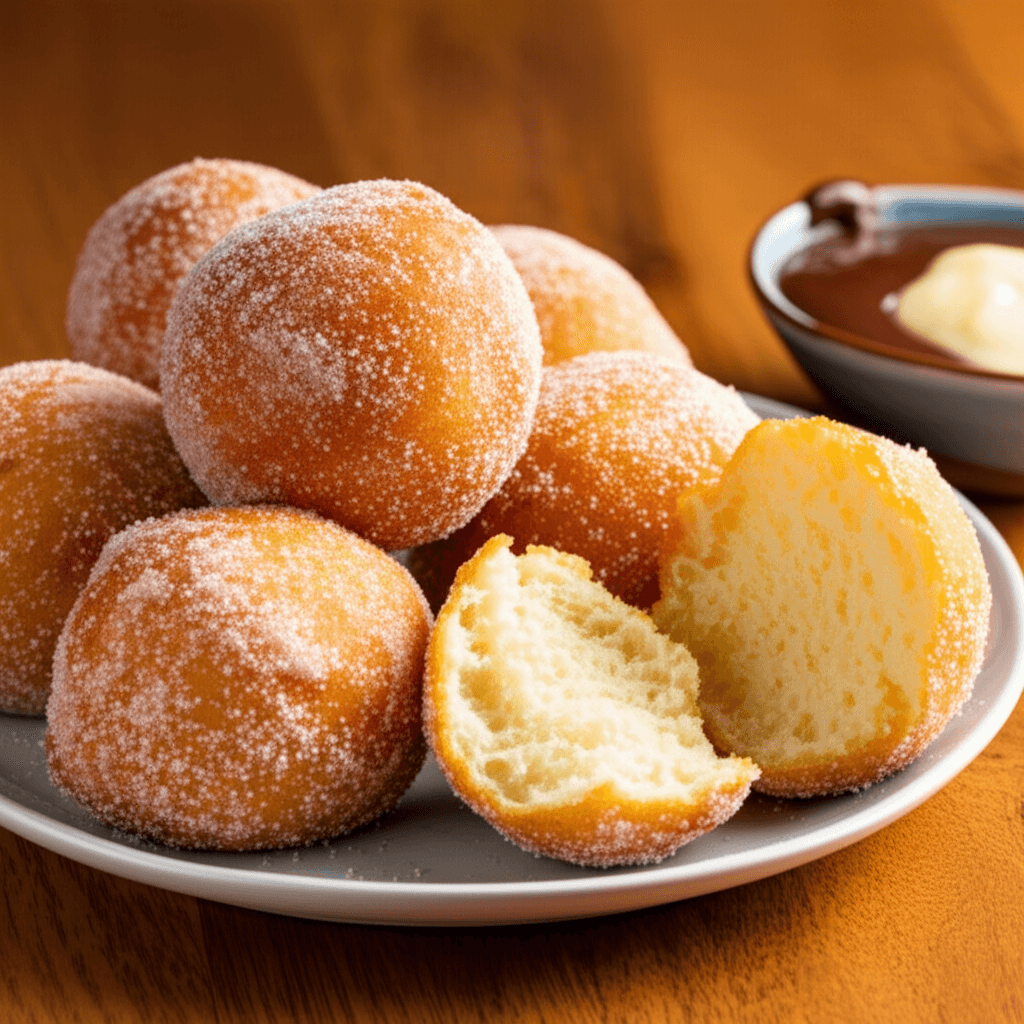
Malasadas – Hawaii’s Irresistible Portuguese Donuts
Hawaiian Breakfast

Malasadas – Hawaii’s Irresistible Portuguese Donuts

February 19, 2026 by CurtisJ 50 minutes

There is a line out the door at Leonard’s Bakery on Kapahulu Avenue at 5:30 in the morning, and it will stay that way until they close. It’s been that way for decades. People don’t wait in line for thirty minutes at dawn for just any donut — they wait for malasadas. And if you’ve ever had one fresh from the fryer, still warm, the outside coated in granulated sugar that crunches lightly as your teeth sink through to the soft, pillowy, slightly eggy dough inside — you understand completely.

Malasadas are Portuguese donuts, brought to Hawaii by immigrants from the Azores and Madeira Islands who came to work the sugar plantations in the late 1800s. Unlike American donuts, malasadas have no hole and no glaze. They’re egg-enriched, yeasted dough balls, deep-fried until golden and rolled in sugar while still hot. That’s it. No frosting, no sprinkles, no cream cheese drizzle. Just perfect dough, perfect frying, and sugar. The simplicity is what makes them extraordinary.

The Portuguese Legacy in Hawaii

Portuguese immigrants arrived in Hawaii starting in the 1870s, primarily from the Azores and Madeira, recruited to work on the sugar plantations. They brought with them a rich culinary tradition that has become deeply embedded in Hawaiian food culture. Portuguese sausage is a breakfast staple on every island. Portuguese bean soup is a local comfort food classic. Portuguese sweet bread became the foundation of Hawaiian sweet rolls. And malasadas became, arguably, the most beloved donut in the Pacific.

The tradition of making malasadas is tied to Shrove Tuesday — the day before Lent, when Catholic families would use up all their sugar, butter, and eggs before the fasting season began. In the Azores, malasadas were the way to use those indulgent ingredients one last time. In Hawaii, the tradition survived and expanded far beyond Lent — malasadas became an everyday treat, a special occasion dessert, and eventually a cultural institution.

Leonard’s Bakery: The Cathedral of Malasadas

You can’t talk about malasadas in Hawaii without talking about Leonard’s. Leonard Rego Jr. opened Leonard’s Bakery in 1952 on Kapahulu Avenue in Honolulu, using his family’s recipe from São Miguel in the Azores. The bakery became famous for its malasadas — light, airy, perfectly fried, rolled in sugar, and served warm. Leonard’s also pioneered the filled malasada, injecting the traditional dough with custard, haupia, guava, and other fillings. Today, the bakery is run by the third generation of the Rego family, and the recipe hasn’t changed.

There are other excellent malasada spots in Hawaii — Champion Malasadas on Beretania, Pipeline Bakeshop in Kaimuki, and the various trucks and pop-ups at farmers’ markets across the islands. But Leonard’s is the standard against which all others are measured.

Making Malasadas at Home

Fair warning: making malasadas at home is a project. The dough needs time to rise, the oil needs careful temperature management, and the timing of rolling them in sugar is important. But the reward is worth it — homemade malasadas, hot from the fryer, are one of life’s genuine pleasures. And the smell of your kitchen while they’re cooking is enough to make your neighbors knock on the door.

Ingredients

For the Dough

  • 1 package (2 1/4 teaspoons) active dry yeast
  • 1/4 cup warm water (105-110°F)
  • 1 teaspoon sugar (for activating yeast)
  • 3/4 cup whole milk, warmed
  • 1/4 cup (1/2 stick) unsalted butter, melted and cooled slightly
  • 1/3 cup granulated sugar
  • 3 large eggs, room temperature
  • 4 cups all-purpose flour
  • 1/2 teaspoon salt
  • 1/2 teaspoon vanilla extract
  • Zest of 1/2 lemon (optional, but traditional)

For Frying and Coating

  • Vegetable oil or peanut oil for deep frying (about 2 quarts)
  • 1 cup granulated sugar for rolling

Instructions

Make the Dough

  1. In a small bowl, combine warm water, yeast, and 1 teaspoon sugar. Let it sit for 5-10 minutes until foamy. If it doesn’t foam, your yeast is dead — start over with fresh yeast.
  2. In a large bowl or stand mixer, combine warm milk, melted butter, 1/3 cup sugar, eggs, vanilla, and lemon zest. Whisk to combine.
  3. Add the yeast mixture and stir to incorporate.
  4. Add 2 cups of flour and the salt. Mix until smooth.
  5. Gradually add the remaining 2 cups of flour, mixing until a soft, sticky dough forms. The dough should be softer than bread dough — it will be sticky and that’s OK. Don’t add too much flour or your malasadas will be dense.
  6. If using a stand mixer, switch to the dough hook and knead on medium-low for 5-7 minutes until the dough is smooth, elastic, and pulls away from the sides of the bowl. If kneading by hand, turn out onto a lightly floured surface and knead for 8-10 minutes.
  7. Place the dough in a greased bowl, turn to coat, and cover with plastic wrap or a damp towel.
  8. Let rise in a warm place for 1 1/2 to 2 hours, until doubled in size.

Shape and Fry

  1. Punch down the risen dough. On a lightly floured surface, roll or pat the dough to about 1/2-inch thickness.
  2. Cut into rounds using a 2-inch biscuit cutter or the rim of a glass. Alternatively, you can pull off pieces of dough and roll them into golf-ball-sized balls with lightly oiled hands. Gather and re-roll scraps.
  3. Place the shaped malasadas on parchment-lined baking sheets. Cover and let rise for another 30-45 minutes until puffy.
  4. Fill a large, heavy pot or Dutch oven with 3-4 inches of oil. Heat to 350°F (175°C). Use a thermometer — temperature is critical.
  5. Prepare a plate lined with paper towels and a shallow dish filled with granulated sugar.
  6. Carefully lower 3-4 malasadas into the hot oil using a slotted spoon. Don’t crowd the pot — they need room to float and puff.
  7. Fry for about 1-2 minutes per side, until deep golden brown. They should puff up and float. Use a slotted spoon or chopsticks to flip them.
  8. Remove to paper towels briefly — just 5-10 seconds to drain.
  9. While still hot, roll each malasada in the sugar dish, coating all sides generously. The sugar must go on while they’re hot or it won’t stick.
  10. Repeat with remaining dough, adjusting oil temperature between batches as needed.

Filling Variations

Traditional malasadas are unfilled, but Leonard’s popularized the filled malasada and the tradition has stuck. To fill them:

  • Let the fried, sugared malasadas cool for a few minutes.
  • Fill a piping bag fitted with a long filling tip with your desired filling.
  • Insert the tip into the side of each malasada and squeeze gently until you feel it start to swell.

Popular fillings include:

  • Haupia (coconut pudding): The most Hawaiian option — creamy coconut custard inside a sugar-crusted donut.
  • Custard: Classic vanilla pastry cream, the Leonard’s original filled variety.
  • Guava: Tangy guava puree or guava-cream cheese for a tropical punch.
  • Lilikoi: Passion fruit curd for a tart-sweet surprise.
  • Dobash (chocolate): Rich chocolate custard, inspired by the Hawaiian dobash cake tradition.

Tips for Success

  • Oil temperature is everything. Too hot and the outside burns before the inside cooks. Too cool and the malasadas absorb oil and turn greasy. 350°F is the sweet spot. Use a thermometer and adjust the heat between batches.
  • Don’t rush the rise. The long first rise develops flavor and creates that light, airy texture. If your kitchen is cool, let the dough rise in the oven with just the light on.
  • Eat them fresh. Malasadas are at their absolute best within 15 minutes of frying. They’re still good later, but that fresh-from-the-fryer moment is transcendent. This is not a make-ahead dessert — it’s a make-right-now dessert.
  • Make it an event. Frying malasadas at home is a social activity. Get people in the kitchen, have someone on frying duty, someone on sugar-rolling duty, and everyone on eating duty. Put on some music. It’s a party.

Prep Time: 30 minutes | Rise Time: 2 hours | Cook Time: 20 minutes | Makes: about 24 malasadas

Malasadas – Hawaii’s Irresistible Portuguese Donuts

Prep 30 minutes
Cook 20 minutes
Total 50 minutes
Servings
4

Ingredients

Instructions

1

In a small bowl, combine warm water, yeast, and 1 teaspoon sugar. Let it sit for 5-10 minutes until foamy. If it doesn't foam, your yeast is dead - start over with fresh yeast.

2

In a large bowl or stand mixer, combine warm milk, melted butter, 1/3 cup sugar, eggs, vanilla, and lemon zest. Whisk to combine.

3

Add the yeast mixture and stir to incorporate.

4

Add 2 cups of flour and the salt. Mix until smooth.

5

Gradually add the remaining 2 cups of flour, mixing until a soft, sticky dough forms. The dough should be softer than bread dough - it will be sticky and that's OK. Don't add too much flour or your malasadas will be dense.

6

If using a stand mixer, switch to the dough hook and knead on medium-low for 5-7 minutes until the dough is smooth, elastic, and pulls away from the sides of the bowl. If kneading by hand, turn out onto a lightly floured surface and knead for 8-10 minutes.

7

Place the dough in a greased bowl, turn to coat, and cover with plastic wrap or a damp towel.

8

Let rise in a warm place for 1 1/2 to 2 hours, until doubled in size.

9

Punch down the risen dough. On a lightly floured surface, roll or pat the dough to about 1/2-inch thickness.

10

Cut into rounds using a 2-inch biscuit cutter or the rim of a glass. Alternatively, you can pull off pieces of dough and roll them into golf-ball-sized balls with lightly oiled hands. Gather and re-roll scraps.

11

Place the shaped malasadas on parchment-lined baking sheets. Cover and let rise for another 30-45 minutes until puffy.

12

Fill a large, heavy pot or Dutch oven with 3-4 inches of oil. Heat to 350°F (175°C). Use a thermometer - temperature is critical.

13

Prepare a plate lined with paper towels and a shallow dish filled with granulated sugar.

14

Carefully lower 3-4 malasadas into the hot oil using a slotted spoon. Don't crowd the pot - they need room to float and puff.

15

Fry for about 1-2 minutes per side, until deep golden brown. They should puff up and float. Use a slotted spoon or chopsticks to flip them.

16

Remove to paper towels briefly - just 5-10 seconds to drain.

17

While still hot, roll each malasada in the sugar dish, coating all sides generously. The sugar must go on while they're hot or it won't stick.

18

Repeat with remaining dough, adjusting oil temperature between batches as needed.

Chef's Notes

- Oil temperature is everything. Too hot and the outside burns before the inside cooks. Too cool and the malasadas absorb oil and turn greasy. 350°F is the sweet spot. Use a thermometer and adjust the heat between batches. - Don't rush the rise. The long first rise develops flavor and creates that light, airy texture. If your kitchen is cool, let the dough rise in the oven with just the light on. - Eat them fresh. Malasadas are at their absolute best within 15 minutes of frying. They're still good later, but that fresh-from-the-fryer moment is transcendent. This is not a make-ahead dessert - it's a make-right-now dessert. - Make it an event. Frying malasadas at home is a social activity. Get people in the kitchen, have someone on frying duty, someone on sugar-rolling duty, and everyone on eating duty. Put on some music. It's a party. Prep Time: 30 minutes | Rise Time: 2 hours | Cook Time: 20 minutes | Makes: about 24 malasadas