Before you read
Breakfast in Hawaii did not appear out of nowhere.
The plate people now call a Hawaiian breakfast is the result of centuries of change, migration, labor, and adaptation. CurtisJ's frame is to see the breakfast table as a running history lesson: indigenous foodways, plantation influences, military shortcuts, and local habits all stacked on the same plate.
Hawaiian breakfast didn’t always look the way it does now. The Spam-and-eggs plate that locals eat every morning is the product of a thousand years of evolution — from ancient Hawaiian staples to plantation-era fusion to the military influence of World War II. Every ingredient on that plate has a story, and every story connects to a different chapter of Hawaii’s history.
Understanding how Hawaiian breakfast evolved helps you understand Hawaii itself. The islands have always absorbed new cultures without losing the old ones, and nowhere is that more visible than at the morning table.
Before Contact: The Ancient Hawaiian Morning
Ancient Hawaiians didn’t have a formal “breakfast” in the way we think of it. They ate when they were hungry, usually twice a day — once in the late morning after early work was done, and again in the evening. The morning meal was simple and built around what the land and sea provided.
The foundation was poi — pounded taro root mixed with water into a smooth, starchy paste. Poi was more than food; Hawaiians considered taro (kalo) to be a literal ancestor, the elder brother of the Hawaiian people. The poi bowl sat at the center of every meal, and tradition held that arguments stopped when it was uncovered.
Alongside poi, a morning meal might include:
- Baked sweet potato (ʻuala): Cooked in the coals of a fire or in the imu, sweet potatoes were a portable, energy-dense morning food
- Fresh fish: Raw or dried, depending on the catch. Coastal families ate fish at nearly every meal
- Breadfruit (ʻulu): Roasted or steamed, a starchy staple similar in role to poi
- Coconut: Eaten fresh, or the water drunk as a morning beverage
- Limu (seaweed): Gathered from the reef, eaten fresh as a mineral-rich side
There was no rice. No eggs. No meat at most meals — pig was reserved for ceremonies and celebrations, cooked whole in the imu (underground oven). The ancient Hawaiian morning meal was plant-forward, seafood-supplemented, and deeply connected to the natural abundance of the islands.
The Plantation Era: Everything Changes (1850s–1940s)
The arrival of sugar plantation workers from Japan, China, Portugal, the Philippines, and Korea between the 1850s and early 1900s transformed Hawaiian food more dramatically than any other event in the islands’ history. Each group brought their breakfast traditions, and over decades of living side by side in plantation camps, those traditions merged into something entirely new.
Japan Brings Rice
This is the single biggest shift in Hawaiian breakfast history. Japanese workers brought their rice tradition — short-grain white rice, cooked in a pot every morning, served as the base of every meal. Within a generation, rice had replaced poi and sweet potato as the default morning starch for most of Hawaii’s population.
The Japanese also brought furikake (rice seasoning), nori (dried seaweed), and the concept of onigiri (rice balls), the direct ancestor of Spam musubi. Tamagoyaki (rolled omelette) showed up at breakfast tables too, introducing the eggs-and-rice combination that would become the island standard.
Portugal Brings Sausage and Sweet Bread
Portuguese immigrants from the Azores and Madeira arrived in the 1870s and 1880s, bringing linguiça sausage and pão doce (sweet bread). Hawaii adapted both: the sausage became “Portuguese sausage”, slightly sweeter and milder than the original, and sweet bread became the foundation of Hawaiian sweet bread French toast and malasadas.
Portuguese sausage with eggs and rice became a breakfast combination so fundamental that it’s still served at every local diner in Hawaii. Brands like Redondo’s and Gouvea’s have been making it for over a century.
China Brings Fried Rice and Char Siu
Chinese workers brought the technique of stir-frying day-old rice with whatever was on hand — vegetables, bits of meat, eggs. This became the foundation of Hawaiian-style fried rice, which shows up at breakfast in omelets, as a side dish, and as a main. Char siu (sweet roasted pork) also made its way into morning meals, diced into fried rice or served as a breakfast protein.
The Philippines Brings Garlic Rice
Filipino workers brought sinangag, garlic fried rice, and the tradition of a hearty, garlicky morning meal. Filipino breakfast in Hawaii often meant rice fried with garlic, a fried egg, and a protein like longganisa (sweet sausage) or tocino (cured pork). That garlic-forward flavor became part of the broader Hawaiian breakfast palette.
Korea Brings Kimchi and Banchan
Korean workers added their own morning flavors: kimchi alongside rice and eggs, and the concept of small side dishes (banchan) at breakfast. Kalbi for breakfast, grilled short ribs with rice and eggs, became a local favorite, especially on weekends.
The Camp Kitchen Effect
The magic wasn’t just that all these cultures were in Hawaii — it’s that they were cooking next to each other. Plantation camp kitchens were shared spaces. A Japanese family’s rice cooker sat next to a Portuguese family’s sausage pan. Kids traded lunches. Neighbors shared recipes. Over time, the boundaries between cuisines blurred.
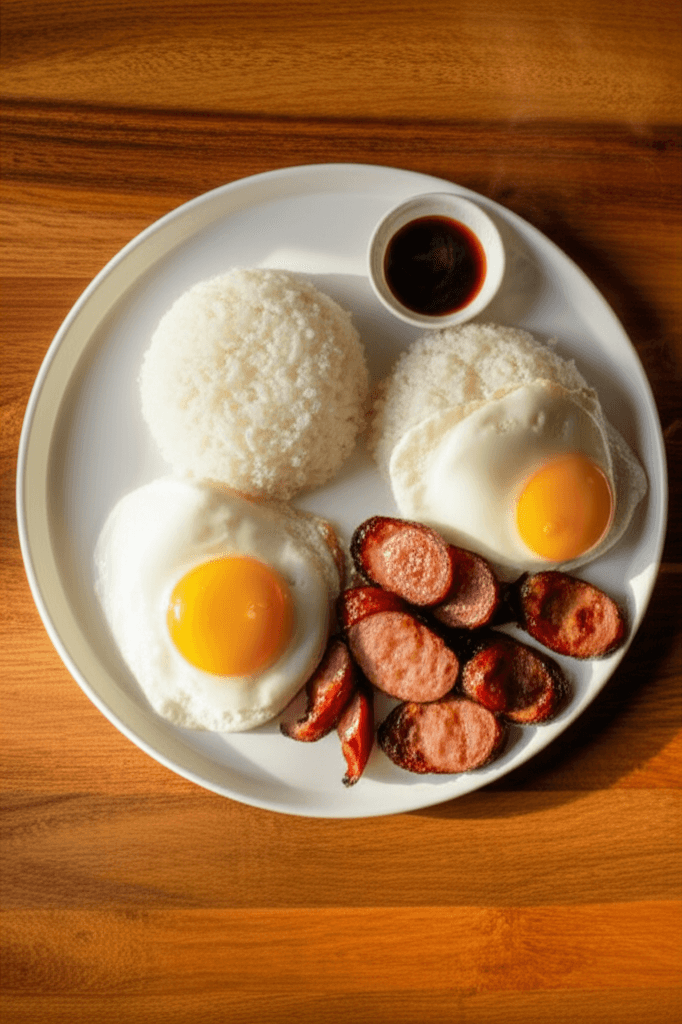
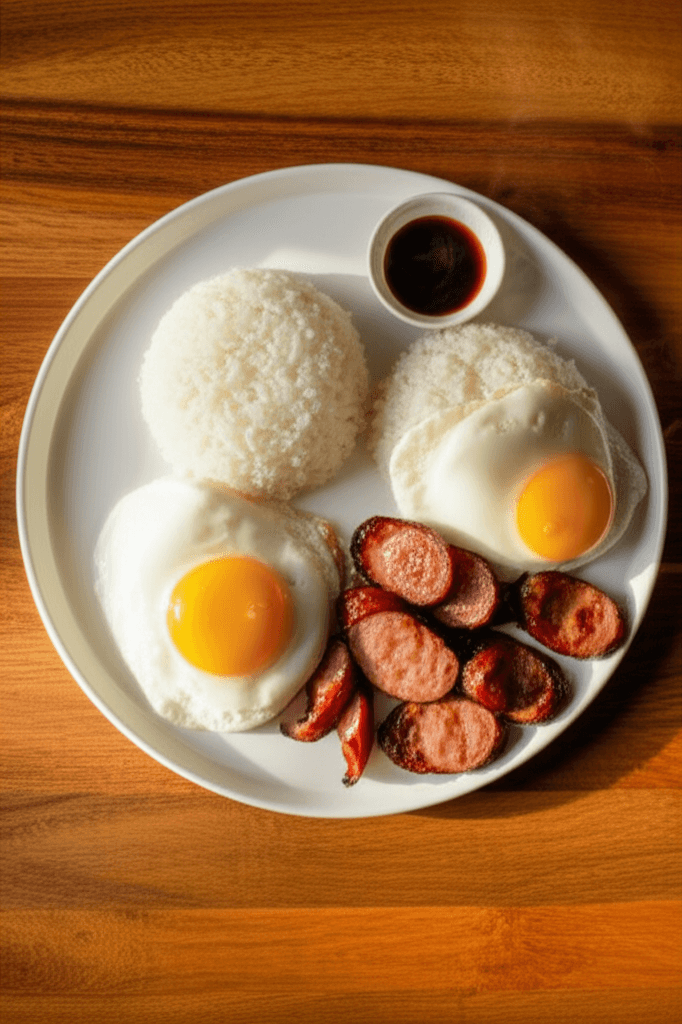
By the early 1900s, a “local” breakfast had emerged that belonged to no single culture: rice (Japanese), eggs (universal), Portuguese sausage or Spam (Portuguese/American), with shoyu on the table (Japanese) and hot sauce optional (multi-origin). This is essentially the same breakfast locals eat today.
World War II: Spam Arrives (1940s)
The attack on Pearl Harbor in 1941 changed Hawaii’s food supply overnight. Fishing was restricted. Fresh meat was rationed. The military, which flooded the islands with hundreds of thousands of servicemen, brought enormous quantities of canned goods and none more than Spam.
Hormel’s canned meat was designed for military logistics: shelf-stable, protein-dense, cheap. The military distributed it widely, and Hawaii’s residents, already skilled at cooking with simple, affordable ingredients, adopted it immediately. Spam fit perfectly into the existing rice-and-eggs breakfast framework. Slice it, fry it, serve it alongside rice. Done.
After the war, Spam stayed. It wasn’t a compromise anymore — it was a preference. Hawaii’s love affair with Spam has now lasted over eighty years, and the state consumes roughly seven million cans per year. Spam and eggs with rice isn’t a wartime relic. It’s a daily ritual.
The military also brought other canned proteins that became breakfast staples: corned beef hash and Vienna sausage, both fried up and served with rice and eggs in the same pattern.
The Diner Era: Breakfast Goes Public (1950s–1980s)
After statehood in 1959, Hawaii’s economy shifted from agriculture to tourism and services. The plate lunch, originally a plantation worker’s boxed lunch, moved into restaurants and drive-ins. Breakfast got the same treatment.
Diners like Rainbow Drive-In (opened 1961), Zippy’s (opened 1966), and Liliha Bakery became institutions. They codified what a “local breakfast” meant: a choice of protein (Spam, Portuguese sausage, bacon, ham), two eggs any style, two scoops rice. Coffee. Maybe a side of toast, but the rice was the point.
Loco moco was born in this era — created at Lincoln Grill in Hilo in 1949. A hamburger patty on rice, topped with gravy and a fried egg. It started as a cheap, filling meal for teenagers and became Hawaii’s most famous breakfast dish. Every diner now has its own version.
This era also established breakfast as a social ritual. Local diners became gathering places — somewhere to eat before work, after surfing, after church. The food was consistent, affordable, and comforting. Many of these restaurants haven’t changed their menus in decades because nobody wants them to.
The Modern Morning: New Additions, Same Foundation (1990s–Today)
Hawaiian breakfast today has more options than ever, but the core hasn’t shifted. Rice, eggs, and a protein still dominate the weekday morning. What’s changed is the addition of lighter alternatives and specialty items that coexist with the classics.
The Acai Bowl Wave
Starting in the 2000s, acai bowls swept through Hawaii, especially among surfers and health-conscious younger locals. Thick frozen acai topped with granola, fruit, and honey became a morning staple at juice bars and cafes across the islands. It’s a genuine addition to the breakfast landscape, not a replacement for Spam and eggs, but a different option for different mornings.
Coffee Culture
Hawaii has always been a coffee-drinking state, Kona coffee is world-famous, but the specialty coffee movement brought new energy to island mornings. Local-style iced coffee, cold brew, and single-origin pour-overs now sit alongside the traditional drip pot. The coffee changed; the rice and eggs didn’t.
The Brunch Scene
Brunch, the mainland concept of a late, elaborate weekend breakfast, arrived in Hawaii’s restaurant scene in the 2010s. Hawaiian Eggs Benedict with kalua pork, taro waffles, and poi pancakes represent a new generation of Hawaiian breakfast food: dishes that honor local ingredients while borrowing the brunch format.
But here’s the thing: even at the fanciest brunch spot in Kailua, the table next to you is probably ordering Spam and eggs. The foundation holds.
Why It Matters
Hawaiian breakfast is a history lesson disguised as a meal. Every ingredient tells you something about who came to Hawaii, when they came, and what they brought with them. The rice is Japanese. The sausage is Portuguese. The Spam is American military. The eggs are universal. The shoyu on the table is Japanese again. The POG juice in the glass is a 1970s Hawaiian invention.
No single culture owns Hawaiian breakfast. All of them do. And that’s what makes it one of the most interesting morning meals anywhere in the world.
For the complete guide to every Hawaiian breakfast dish, from the everyday classics to weekend showstoppers, check out our Ultimate Guide to Hawaiian Breakfast. And to see what a real local morning looks like today, read What Do Hawaiians Actually Eat for Breakfast.