Before you cook
Smoke, salt, and patience carry this one.
Kalua pig does not need a long ingredient list to make its point. CurtisJ's frame is to understand the imu first, then the way smoke, steam, and time turn a whole hog into the plate people wait for.
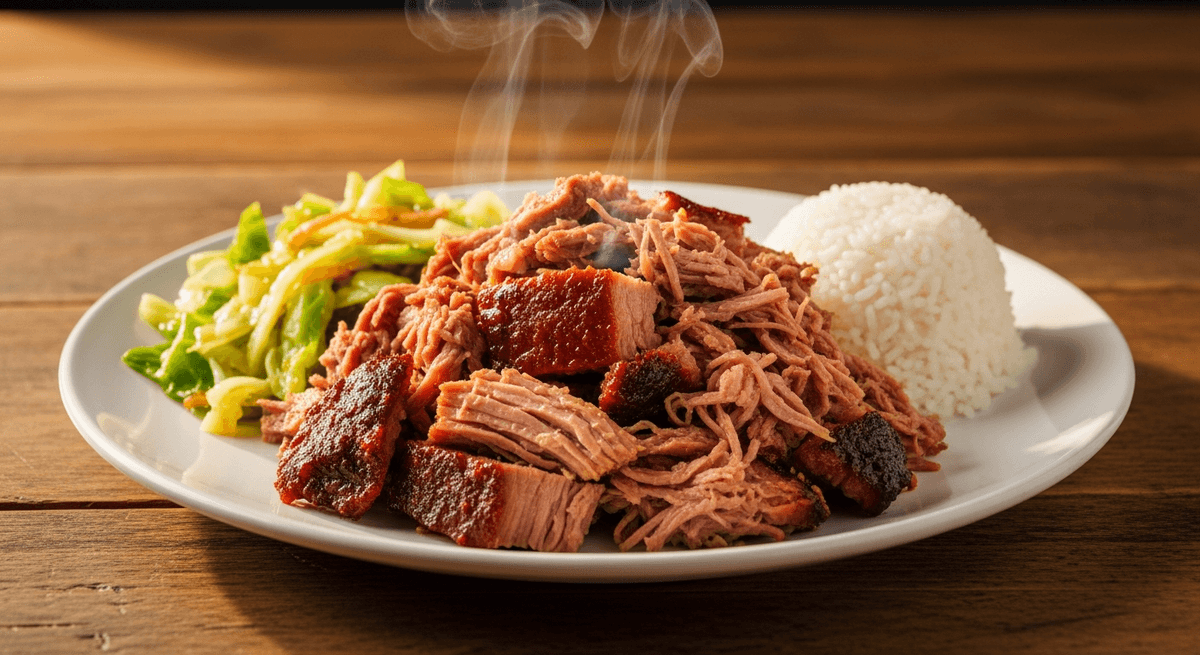
Kalua pig is Hawaii’s most classic whole-hog preparation, a whole pig slow-cooked in an imu (underground oven) until the meat is impossibly tender, smoky, and shreddable. It’s the centerpiece of every traditional luau and the foundation of Hawaiian feast culture. If you’ve been to a luau, the smoky pulled pork you ate over rice was kalua pig.
The name comes from “kālua,” which means “to cook in an underground oven.” This isn’t a seasoning style or a sauce, it’s a cooking method that dates back centuries, long before European contact with the Hawaiian Islands.
How Traditional Kalua Pig Is Made
The traditional method is a communal event that takes the better part of two days:
- Dig the imu. A large pit is dug in the ground, typically 3-4 feet deep and wide enough for a whole pig.
- Build the fire. The pit is lined with porous lava rocks and a large fire is built on top. The rocks heat for several hours until they’re glowing hot.
- Prepare the pig. A whole pig (typically 100+ pounds) is cleaned, salted inside and out with Hawaiian sea salt, and sometimes stuffed with hot rocks to cook from the inside.
- Wrap in leaves. The pig is wrapped in banana leaves and ti leaves, which protect the meat and add subtle flavor during cooking.
- Bury and cook. The wrapped pig is placed on the hot rocks, covered with more banana leaves, burlap, and then buried with earth. It steams underground for 8-12 hours.
- Unearth and shred. The pig is carefully dug up, unwrapped, and the fall-apart tender meat is shredded by hand.
The result is pork with a deep, smoky flavor from the lava rocks and banana leaves, seasoned with nothing but salt. The texture is unlike any other pulled pork — silky, tender, and almost melting.
Making Kalua Pig at Home
Unless you have a backyard and an afternoon to dig a pit, you’ll want the oven or slow cooker method. The secret ingredient for the home version is liquid smoke, a few drops replicate the smoky flavor of the imu without the underground oven.
The home method uses a pork butt (Boston butt) or pork shoulder, rubbed with Hawaiian sea salt and a small amount of liquid smoke, then slow-roasted wrapped tightly in foil or in a slow cooker for 8-12 hours. The result is remarkably close to the real thing — smoky, salty, tender, shreddable pork.
Get the full recipe: Oven-Roasted Kalua Pig
How Kalua Pig Is Served
Kalua pig is versatile, it shows up across Hawaiian food culture:
- At the luau table: the star of every traditional luau, served alongside poi, lomi salmon, chicken long rice, and haupia
- As a plate lunch: over two scoops rice with mac salad at any plate lunch counter
- In nachos and sliders: modern Hawaiian restaurants use kalua pig in fusion dishes
- In eggs: kalua pig hash with eggs is a classic Hawaiian breakfast
- In sandwiches: piled high on a soft roll with cabbage slaw
Kalua Pig vs. Mainland Pulled Pork
They look similar, both are shredded pork, but they’re fundamentally different:
- Seasoning: Kalua pig uses only salt and smoke. Mainland pulled pork uses dry rubs with dozens of spices.
- Sauce: Kalua pig has no sauce. Mainland BBQ pulled pork is defined by its sauce (vinegar, mustard, tomato, etc.).
- Smoke source: Kalua pig gets its smoke from lava rocks and ti leaves in an underground oven. Mainland BBQ uses wood smoke in an above-ground smoker.
- Simplicity: Kalua pig is pure — meat, salt, smoke. That minimalism is what makes it Hawaiian.
Explore More Hawaiian Traditions
- Kalua Pig Recipe — Make it at home in your oven
- Talk Story: The Luau, The cultural tradition built around kalua pig
- What Is Laulau? — Another traditional leaf-wrapped Hawaiian dish
- What Is a Plate Lunch?, Where kalua pig meets rice and mac salad
- The Plate Lunch Guide — Every protein, every recipe
- Hawaiian Backyard Party Guide, How to throw your own kalua pig feast