Before you set the timer
Kalua pig in the Instant Pot is not a shortcut. It is the version you actually cook on a Tuesday.
The slow-cooker version gives you 8 hours of flavor development and zero attention required. The smoker version gives you the closest home imu approximation, with 9 hours of fire-tending. The Instant Pot version gives you 90 minutes of pressure-cook and a result that is 90% of the way to either of the other two. Worth knowing.
An imu is a hole in the ground. A pig goes in, the pig comes out 6 to 8 hours later wrapped in steam and the smoke of kiawe wood, and that pork, pulled apart into long pale strands seasoned only with Hawaiian salt, is the dish luaus are built around. Kalua pig is one of the few dishes you can taste at a Honolulu hotel luau and at a Saturday backyard birthday party and recognize as the same dish. It is foundational Hawaii food.
The home version is always a compromise. The slow-cooker version swaps fire and earth for a Crock-Pot. The smoker version swaps the imu for a Weber. The Instant Pot version swaps both for pressure and steam, and finishes in under two hours. None of them is the imu. All of them are kalua pig if you handle the salt and the smoke right.
Why pressure cooking works for kalua
Kalua pork is defined by texture as much as flavor. The strands should pull apart with a fork at the lightest touch, almost like crab-stick or pulled chicken — not like the chunky pulled pork you get on a sandwich. That texture comes from total collagen breakdown, which happens in low-and-slow cooking and also under high-pressure steam.
An imu does it through 6 hours of underground heat. A slow cooker does it through 8 hours at 200°F. A pressure cooker does it through 90 minutes at 250°F under 15 PSI. The molecular outcome is the same: collagen melts, fibers separate, the meat shreds clean.
What pressure cooking cannot give you is real smoke. Liquid smoke is the workaround, and it is closer than skeptics give it credit for — the bottle is itself a real smoke condensate, captured from real burning wood and concentrated. The flavor reads as a deeply smoked pork as long as you do not over-pour. A teaspoon per pound of pork is the right ratio.
What to get right
1. Pork shoulder, not pork loin. Loin is too lean and turns dry under pressure. Shoulder (sometimes labeled Boston butt) has the marbling and collagen that becomes the kalua texture. Bone-in is slightly better for flavor; boneless is easier to handle. Either works.
2. Cut into chunks, not whole. A 4-pound whole shoulder pressure-cooked for 90 minutes ends up tender on the outside and tough at the bone. Three or four fist-sized chunks pressure-cook evenly all the way through.
3. Hawaiian salt, not table salt. Coarse alaea is the standard. Worth tracking down — most large grocery stores in the western US carry it now, and any Hawaii-foods aisle of a Pacific-region market will have it. The grain is the point: coarse salt sits on the surface and dissolves into the meat slowly during the cook.
4. Banana leaves if you can find them. Frozen banana leaves run 3 to 5 dollars at any Latin or Asian grocery and they make a difference. The leaves trap aromatic vapor against the pork during the cook. Ti leaves are more traditional but harder to source on the mainland. If you have neither, the recipe still works, but it tastes more like seasoned pork shoulder than true kalua.
The cabbage version
The Hawaii plate-lunch standard is kalua pork with cabbage — a scoop of pork and a scoop of wilted cabbage together on the rice. The cabbage gets cooked in the pork drippings at the very end, in 4 to 5 minutes on sauté. It should still have bite when it lands on the plate; mushy cabbage is a sign you cooked it too long. Most plate-lunch counters in Honolulu (Helena's, Highway Inn, Rainbow's) serve it this way.
The cabbage step is optional but recommended. Without it the kalua is great over rice on its own; with it you have the full plate-lunch format. Do both versions a couple of times and find your preference.
What about the imu, really
If you are at a luau in Hawaii and the host is doing a real imu, what you are tasting is not pressure cooking and it is not slow cooking. It is dry-heat steaming under earth, with kiawe smoke working the surface for hours. The result is silkier than any home version — the strands are more delicate, the smoke deeper, the salt more thoroughly bonded to the meat. Eat it whenever you have the chance.
The home version is honest about being a home version. It is what you cook when you want kalua pork on a Tuesday and you do not have a backyard fire pit, four hours of free time, or a banana-leaf-trained network. The Instant Pot version, run correctly, lands at maybe 80% of a slow-cooker version and 70% of a smoker version. That is enough on a weeknight.
The plate
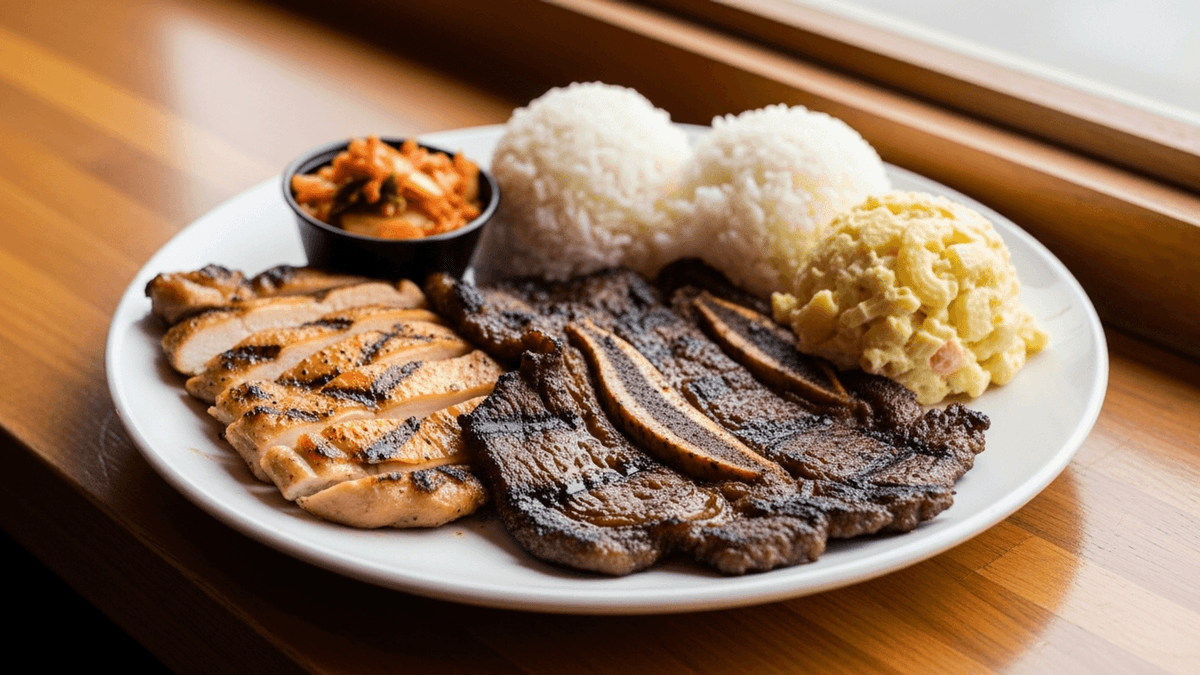
- Two scoops of white rice (Calrose, short-grain)
- A scoop of Hawaiian mac salad
- A pile of kalua pork (and cabbage if you cooked it)
- Optional: a small mound of poi or sweet potato
This is the standard Hawaii plate-lunch arrangement. See the Hawaii plate lunch guide for how the format works and what else fits the rotation. For the side-by-side breakdown of how kalua pig compares to mainland BBQ, see kalua pig vs pulled pork, they are not the same dish, and the comparison explains why.
Storage and reheating
Cooked kalua pig keeps in the fridge for up to 5 days in an airtight container with the cooking liquid. Reheat in a covered skillet over low heat with a splash of the liquid, or in a microwave on 50% power covered with a damp paper towel. Frozen, it holds for up to 3 months — defrost in the fridge before reheating.
Leftovers run in three good directions: kalua-pig fried rice (the morning-after move), kalua-pig sliders on King's Hawaiian rolls (the next-day lunch), or a kalua quesadilla with cheese and pickled onion (the dinner-on-the-couch move). The cooking liquid carries all three — keep it.