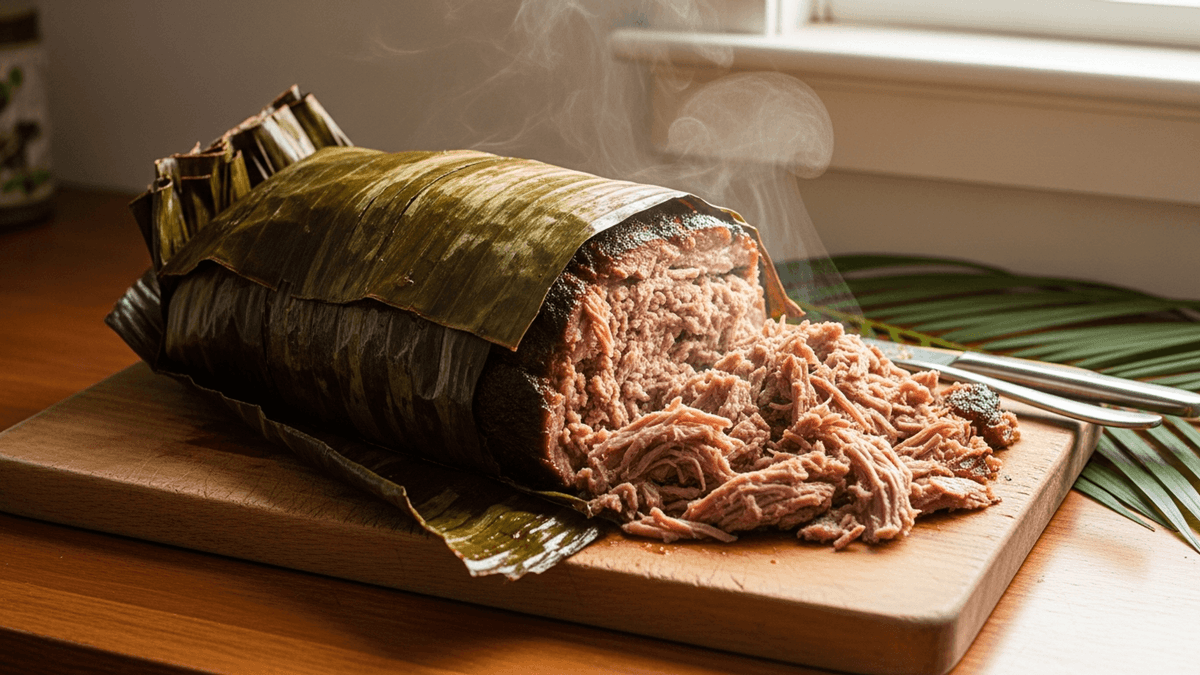
Before you cook
A smoker can cover about 90 percent of what an imu does.
The imu matters because of three things: banana-leaf steam, kiawe smoke, and long low heat. A home smoker can reproduce all three with the right setup. It will not be the same as an imu kalua at a luau on the Big Island, but it will be noticeably closer than the slow-cooker version and a long way from any mainland pulled pork.
Traditional Hawaiian kalua pig is cooked in an imu: an underground pit lined with hot lava rocks, banana leaves, and ti leaves, with a whole pig (or large pork shoulder) buried for 8 to 12 hours. The steam, the smoke, and the pressure of the leaves pressing against the meat are what produce the texture and flavor that make kalua the centerpiece of a luau plate. See what kalua pig is for the cultural background.
Not everyone has a backyard imu. For most home cooks, the choice is between the oven version (reliable, dry, uses liquid smoke), the slow-cooker version (hands-off, moist, weeknight-friendly), and this smoker version (closer to the imu, requires a smoker and patience). Each has its place. This is the recipe for the cook who already owns a smoker and wants the best at-home approximation.
Why this works
The imu gives kalua three things: long slow cooking, real wood smoke, and steam contained by banana leaves. A home smoker running at 225°F with kiawe or mesquite wood gives you the first two. Banana leaves wrapped tight around the pork give you the third. The combination lands on the short list of techniques that produce actual shredded, salt-and-smoke kalua texture.
The trade-off: a smoker run takes 8 to 10 hours of monitoring. Not constant attention (pellet smokers can run mostly unattended; offset smokers need tending every 45 minutes), but a commitment. Start early in the morning if you want dinner-time kalua. Start the night before if you want the bundle finished for an afternoon party.
What to get right
The wood
Kiawe (Hawaii mesquite) is the traditional choice. Real kiawe is hard to source on the mainland, but mesquite is the closest commercial substitute and gives the same aggressive, sweet-savory smoke character. Hickory is a distant third — more bacon-like, less direct. Avoid apple, cherry, or oak for this — they are too mild and the kalua flavor gets subtle in ways it should not.
The banana leaves
Banana leaves do two jobs: they steam the meat from contact, and they impart a faint earthy-vegetal note that is part of real kalua. Frozen banana leaves from an Asian market are fine — thaw them overnight and wipe dry. Do not substitute corn husks, parchment, or foil; the flavor is meaningfully different.
The salt
Hawaiian sea salt is the primary seasoning. Two tablespoons on a 6-to-7-pound shoulder sounds aggressive; it is the correct amount. Kalua is fundamentally a salt-cured-then-smoked dish. Under-salted kalua tastes flat. Coarse kosher salt works if Hawaiian is not available; use slightly less (1.5 tablespoons) since kosher crystals are smaller.
The smoker temperature
225°F, held steady. Too hot and the banana leaves char and the pork dries. Too cool and the cook stretches beyond reasonable and the smoke penetration suffers. Use the smoker's built-in probe or a standalone thermometer to confirm the pit temperature — many pellet and electric smokers run 15 to 20°F different from the dial.
How to serve smoker kalua
The default plate: shredded kalua mounded over two scoops of rice, a scoop of Hawaiian mac salad, chili pepper water on the side. For a fuller luau-style spread: kalua plus lomi salmon, poi, and cabbage. See the plate lunch guide for the full format.
Leftover kalua is better than a lot of fresh meats. Fold cold shredded kalua into fried rice, loaded fries, scrambled eggs, or tacos. It freezes well in 1-pound portions for up to 2 months — defrost in the fridge overnight, reheat covered in a skillet with a splash of water or broth.
When to use which kalua method
- Slow cooker: weeknights, no smoker, low effort. See the slow-cooker version with cabbage.
- Oven: no smoker, but you want a slightly more caramelized bark. See the oven version.
- Smoker (this guide): weekend cook, you have the gear, you want the closest at-home approximation to imu kalua.
- Real imu: luau, catering, or a backyard project involving digging a pit and sourcing kiawe wood. Most home cooks will not do this, and that is fine.