Before you cook
Spam is a technique, not a novelty.
Musubi is where most mainland cooks stop with Spam. In Hawaii, it is a pantry workhorse — fried rice filler, breakfast plate, sandwich meat, noodle topping, soup ingredient. The technique that unlocks all of it is the same: slice, sear, brown, and season the edges. Once the pan work is right, the applications open up.
Spam entered Hawaii during WWII, integrated into Japanese, Chinese, and Filipino breakfast traditions in the islands, and never left. Hawaii now eats roughly seven million cans a year, more per capita than anywhere else in the US. Most mainland cooks who hear "Hawaii food" think immediately of spam musubi, and musubi deserves the attention — see what spam musubi is and the classic musubi recipe.
But local cooks use Spam for a lot more. This guide is about the technique that makes Spam good, and the nine everyday Hawaii dishes it shows up in once you have the pan work down.
The technique that makes Spam work
Slice thickness matters
A 12-ounce can of Spam slices into six standard 1/4-inch slabs. That thickness works for most applications: fries evenly, keeps a meaty center, and holds up on a plate without shrinking into jerky.
- 1/4-inch slabs are the default for musubi, Spam and eggs, sandwiches, and plate lunches.
- 1/8-inch thin slices are for Spam ramen/saimin toppings and crispy chip applications — they crisp faster and read as seasoning rather than protein.
- Small dice (1/4-inch cubes) are for Spam fried rice, Spam pasta, omelette fillings. Brown the cubes hard first to render the fat and build flavor into the pan.
Tip: freeze the can for 15 minutes before slicing. Firm Spam slices cleanly with a sharp knife; room-temperature Spam squishes and tears.
Caramelize, do not just heat
Spam out of the can is flat-tasting, rubbery, and greasy. Spam caramelized in a hot dry pan is a different food. The move:
- Heat a non-stick or cast-iron skillet over medium-high until a drop of water sizzles and evaporates in 2 seconds.
- Lay the slices in the pan without oil — Spam has plenty of fat already.
- Sear 2 to 3 minutes per side without moving them. The edges should darken to a deep mahogany color.
- For the plate-lunch glaze: in the last 60 seconds, drop a tablespoon of soy sauce and a teaspoon of brown sugar into the pan. Tilt the pan to coat the slices and let the glaze reduce and caramelize against the hot surface. Pull the pan off the heat before the glaze burns.
The glaze step is optional but it is what separates home Spam from Hawaii-diner Spam. A caramelized slice with the sweet-salty edge is the standard.
Nine ways Hawaii cooks use Spam
1. Spam and eggs
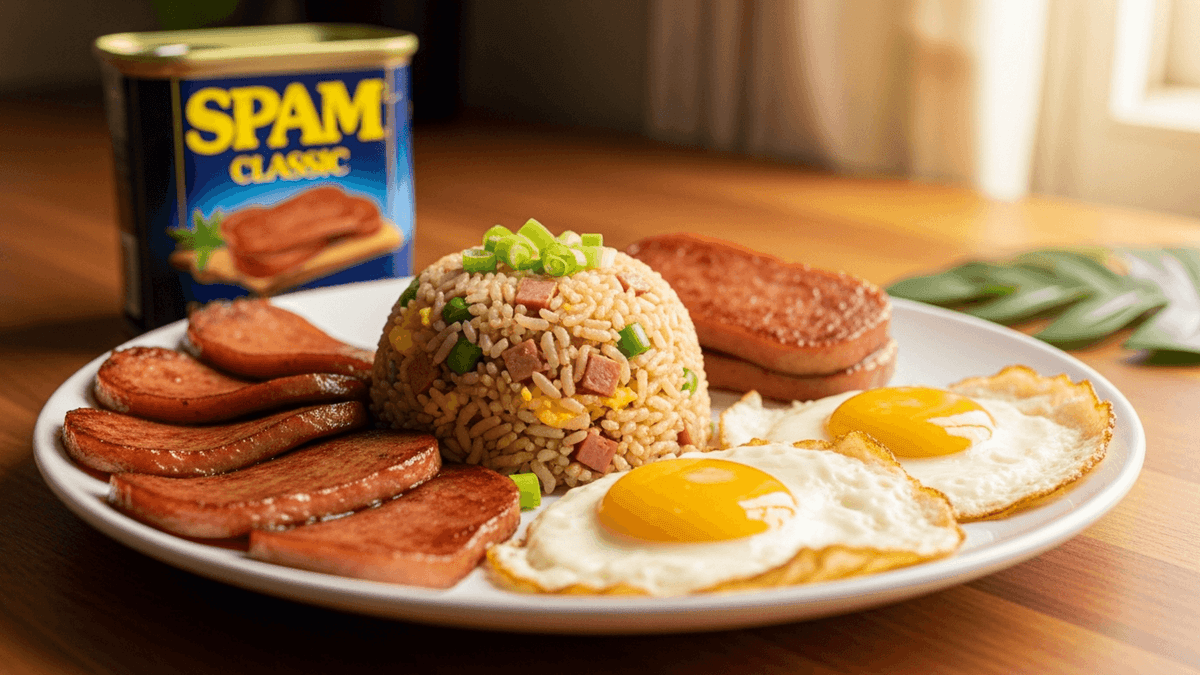
The breakfast standard. Two caramelized slices of Spam, two eggs any style, two scoops of rice, a drizzle of shoyu. This is on every local diner menu in Honolulu. See the full Spam, eggs, and rice breakdown.
2. Spam fried rice
Day-old cold rice, small-diced Spam browned hard to render fat, scrambled egg folded in at the end, green onions and shoyu to finish. The Spam fat is what makes Hawaii-style fried rice different from any other fried rice — it seasons everything else in the pan.
Method: heat a wok or wide skillet, brown 4 ounces of diced Spam until the edges crisp (about 4 minutes). Push to one side, scramble 2 eggs on the empty side, then add 3 cups of cold rice. Stir to combine. Add 1 tablespoon shoyu, 1/2 teaspoon sesame oil, and a handful of sliced green onions in the last 30 seconds. Done.
3. Spam ramen or saimin
Thinly sliced Spam (1/8-inch) crisped in a dry pan until the edges curl and the slices go brittle at the edges. Laid across a bowl of hot saimin or ramen. The crispy edges soften as they absorb broth; the thicker center stays chewy. Salty, umami-forward, immediate.
4. Spam sandwiches
Caramelized Spam, lettuce, tomato, mayo, on a soft bun or between slices of toasted white bread. The Hawaii version often uses a Portuguese sweet roll or King's Hawaiian bread; the slight sweetness of the bun balances the salty Spam. Add a fried egg for a breakfast sandwich.
5. Diced in chow fun or chow mein
Hawaii-Chinese stir-fries often fold in diced Spam alongside char siu or shrimp. The Spam adds salt, fat, and textural variety; it is standing in for the bacon or pancetta you would see in non-Hawaii stir-fries. Small dice, browned hard first, then tossed in with the noodles in the last 90 seconds.
6. Spam musubi
The one you already know. Full recipe at spam musubi; five variations on the classic; the cultural context.
7. Spam loco moco
A variant where Spam slices replace the hamburger patty. Two thick slices of caramelized Spam over rice, brown gravy ladled over, fried egg on top. Salty, comforting, and easier to assemble than a traditional loco moco because the Spam is already cooked-through.
8. Spam in chopped salad or poke-style
Small-diced crispy Spam as a topping on avocado toast, on a chopped salad, or even folded into a non-traditional poke bowl. The Spam adds salt and richness; it stands in for bacon or croutons. A Hawaii-specific move that plays well on a modern plate.
9. Spam fried with cabbage
A cheap weeknight side: shredded cabbage stir-fried in oil until it wilts, then diced Spam browned and tossed in with a splash of shoyu and a little sugar. Works as a side dish alongside rice and a fried egg for a 15-minute dinner. Close cousin to the Korean version of kimchi-and-Spam.
Which Spam variety to buy
Twelve Spam varieties exist as of this writing. Four of them matter for most home cooking:
- Spam Classic. The default. Works for musubi, plate lunch, breakfast, fried rice — anything. If you are buying one can, buy this.
- Spam Less Sodium. 25 percent less salt than Classic. Good for everyday cooking if you are watching sodium; the flavor is slightly muted but the texture is identical.
- Spam Teriyaki. Pre-seasoned with teriyaki. Works in musubi without any additional glaze, but it is easy to match the flavor at home by using Classic plus your own soy-sugar glaze.
- Spam with Portuguese Sausage Seasoning. A Hawaii-market exclusive. Paprika-heavy, garlicky, tastes like a Spam-and-linguiça mashup. Worth ordering online if you want variety, but Classic covers 90 percent of what you would use it for.
Skip: Spam Lite (less fat means less flavor; most Hawaii cooks use Classic even when watching calories). Spam Tocino (Filipino-style sweet cured) is a flavor novelty worth a single try; it works in musubi but is too sweet for most other applications.
Storage and pantry moves
Unopened Spam keeps on the pantry shelf for years (the can date is usually 3 to 5 years out). Once opened, transfer the remaining Spam to an airtight container and refrigerate. Use within 5 days, or freeze the opened Spam in single-slice portions in wax paper for up to 2 months.
The Hawaii-pantry setup keeps 3 to 4 cans of Classic on the shelf at all times. Spam plus rice is a meal; Spam plus rice plus eggs is a plate. For the broader context of how Spam became a staple, see the Spam in Hawaii talk story. For the full plate-lunch format it slots into, see the plate lunch guide.