Before you fry
Fluffy is not a better recipe. It is five small things done right.
Home malasadas go dense or squat for the same handful of reasons every time: weak yeast, wrong proof, cool oil, dry dough, or overworked gluten. Fix those five and the home version lands close to Leonard's without any secret ingredient or special flour.
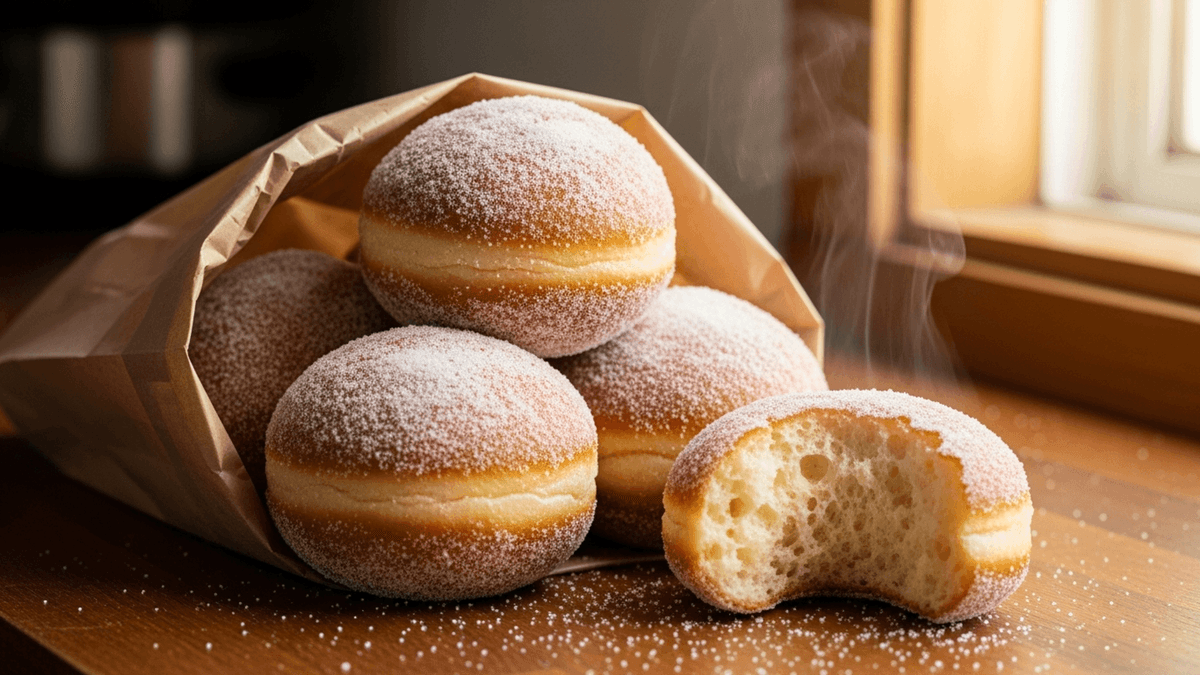
If you have bought malasadas from Leonard's Bakery on Kapahulu in Honolulu, you know what fluffy should feel like. Soft, airy, a little springy, sugar coating still catching light. You tear one open and the interior is yeasty and almost honeycombed — big irregular pockets where the dough rose as it fried. That texture does not happen by accident. It happens because the dough, the proof, and the oil are all doing their specific jobs.
Most home malasadas miss on at least one of those fronts. The bread turns out dense, bready, or greasy. This guide walks through the five common failure modes and the specific fix for each. It assumes you are working from the full malasada recipe or a comparable yeasted-dough recipe — the point here is diagnosing what went wrong and correcting for the next batch.
What a real Hawaii malasada is supposed to taste like
A proper Hawaii malasada is a solid ball of enriched fried dough (no hole in the middle — that is an American donut thing, not a malasada thing) rolled in granulated sugar while still hot. The outside has a thin crisp shell that cracks slightly when you bite. The inside is soft and airy, not cake-like and not chewy. It should weigh noticeably less in your hand than its size suggests.
If the malasada is heavy, dense, greasy, or crumb-tight like a donut, something went wrong. The good news is that each failure mode has a specific cause, and fixing it does not require a different recipe.
The five common failure modes
1. The yeast is not alive
Symptom: dough does not rise during the proof. The final malasada is dense, bready, and heavy.
Cause: old yeast, yeast killed by too-hot liquid, or yeast that never got activated.
The fix:
- Check the date. Yeast loses potency after the expiration date on the packet, especially if the packet has been opened. A sealed fresh packet is the easiest insurance.
- Bloom active dry yeast before adding it to the dough. Warm water at 105°F to 110°F (barely warmer than body temperature; a drop on your wrist should feel warm but not hot), a pinch of sugar, and the yeast. Wait 5 minutes. If the mixture foams and smells yeasty, the yeast is alive. If it stays flat, toss it and start over.
- Instant yeast skips the bloom but still needs the same temperature discipline — water or milk above 115°F starts killing yeast on contact.
2. The dough is over- or under-proofed
Symptom (under-proofed): dough does not quite double, final malasadas are dense and under-risen. Symptom (over-proofed): dough collapses on contact with hot oil, malasadas come out flat and chewy.
Cause: proofing by clock instead of proofing by look.
The fix:
- Proof until the dough roughly doubles, not for a specific number of minutes. Warm kitchens make it fast; cold kitchens slow it down. Typical range: 60 to 90 minutes at room temperature, or 8 to 12 hours in the refrigerator.
- Poke test. Press a floured finger into the dough about a half-inch deep. If the indentation springs back slowly and partially, the dough is ready. If it springs back immediately and fully, keep proofing. If it does not spring back at all, the dough is over-proofed — knock it down and do a shorter second rise.
- Cold overnight retard in the fridge gives the most reliable results for home cooks. The slow fermentation develops flavor and the cold dough holds its shape better when it hits the oil.
3. The oil is too cold (the number-one killer)
Symptom: greasy, heavy, squat malasadas that sit on paper towels leaking oil. The outside is pale gold instead of deep golden brown. The inside is under-cooked or gummy.
Cause: oil temperature drops 15 to 20°F the moment dough hits it, and most home cooks either start with cool oil or do not let the temperature recover between batches.
The fix:
- Use a thermometer. A clip-on candy thermometer on the pot is the single most useful $15 investment for this recipe. Target 365°F to 375°F.
- Small batches. Fry three or four malasadas at a time in a standard pot. Crowding drops the temperature further and steams the dough instead of frying it.
- Let the oil recover. Between batches, watch the thermometer and wait until it climbs back to 365°F before adding the next round. Impatience here is the single biggest reason home malasadas come out greasy.
- Right oil. Neutral-flavored oil with a high smoke point. Vegetable, canola, or peanut oil. Not butter, not olive oil, not coconut oil (too smoky at fry temperature).
4. The dough is too dry or too wet
Symptom (too dry): dough is stiff and hard to shape. Final malasadas are dense and have a tight crumb. Symptom (too wet): dough is sticky and will not hold shape when you try to form portions. Malasadas spread out flat in the oil.
Cause: measuring flour by volume (cups) varies by up to 25 percent depending on how the flour is scooped. Different milks, eggs, and humidity also shift the hydration balance.
The fix:
- Weigh the flour. A digital kitchen scale is the other $15 investment that changes home baking. Malasada dough is typically around 60 to 65 percent hydration (flour weight to liquid weight). If the recipe you are using gives only cup measurements, look up the original weight or use 120 grams per cup as a starting point and adjust.
- Sticky is normal. Properly hydrated malasada dough is sticky. If it is not sticky, it is too dry. Lightly grease your hands with oil to work with it — avoid adding flour, which tightens the gluten.
- Adjust in the bowl. If the dough is too wet to handle after mixing and resting 5 minutes, add flour a tablespoon at a time. If it is too dry, add warm milk a tablespoon at a time. Small corrections; do not panic.
5. The gluten is overworked
Symptom: tough, chewy malasadas that fight back instead of yielding when you bite.
Cause: kneading too long or using a mixer on too-high a speed develops gluten past the point where it stays tender.
The fix:
- 6 to 8 minutes on medium-low with a dough hook. Not 12 minutes on high. Target: the dough pulls away from the bowl sides but still sticks slightly to the bottom.
- Windowpane test, lightly. Pinch off a small piece and stretch it between your fingers. It should stretch thin enough to see light through without tearing. If it tears easily, knead another minute. If it stretches and then snaps back tight, you have over-kneaded and the texture will be chewier than ideal.
- Rest the dough after mixing for 10 minutes before the first proof. This lets the gluten relax and makes the dough easier to shape later.
How to test before committing a full batch
One trick that will save you if you are uncertain: fry a single test malasada before the full batch. Shape one dough ball, drop it in the oil, and see how it behaves.
- Does it float immediately? Oil is hot enough.
- Does it puff and turn evenly? Dough and proof are right.
- Does it come out fluffy when you tear it? You are ready to commit.
- Does it come out dense, greasy, or flat? Adjust before wasting the rest of the dough.
This test only costs one malasada and saves a whole batch.
What Hawaii bakeries do differently
Leonard's, Agnes' Portuguese Bake Shop, Champion, and the handful of other Hawaii bakeries that make malasadas all share a few advantages over home cooks:
- Commercial fryers that recover to target temperature in seconds. Home pots take 1 to 3 minutes.
- Higher-hydration doughs than most home recipes, often 65 to 70 percent. The wetter dough puffs more aggressively in the oil.
- Long overnight retardation in a walk-in cooler. The slow fermentation builds yeasty flavor and lets the dough hold shape during the fry.
- Consistent practice. The workers at Leonard's make thousands of malasadas a week. That repetition is the invisible ingredient.
The home cook cannot fully match the commercial fryer, but hitting the dough hydration, the slow proof, and the oil temperature gets you 90 percent of the way there. That last 10 percent is why a Leonard's malasada hits a little different, and also why they charge what they charge.
Where to start over
If you have been struggling with home malasadas, start with the checklist:
- Fresh instant yeast from a sealed packet
- Digital scale and clip-on thermometer
- Overnight refrigerator proof
- Oil at 365-375°F, small batches, temperature recovery between
- Single test malasada before the full batch
Four out of five home batches improve dramatically on the next try just by adding the thermometer and the scale. The fifth improves on the try after that once you get the hang of the poke test.
For the actual recipe and method, see the full malasada post. For more Hawaii dessert reference points, see the Hawaiian desserts guide. And if home frying is not happening this week, see the Hawaii snacks worth ordering online — Leonard's ships.